Charles Musser

cultural historian/filmmaker/professor

  • About
    • Summary and Links
    • Filmmaking Bio
    • Current Research and Writing
    • Vita
  • Films
    • An American Potter
    • Before the Nickelodeon
    • Errol Morris: A Lightning Sketch
  • Books
  • Recent Essays
  • News
  • Short Pieces
    • Industry’s Disinherited (Union FIlms, 1949)
    • The Investigators (Union Films, 1948)
    • A People’s Convention (Union FIlms, 1948)
    • 1. A Feminist Moment in the Arts: 1910-1913
    • November 28, 2011 Panel Discussion: “Public Humanities, Documentary FIlmmaking and the Academe”
    • Panel Presentation at Yale on February 24, 2010: My Media-Related Research
  • On the Road: Future/Present/Past
  • Contact
  • On the Creative Side: A History of Film and Media Production Courses at Yale
  • Writing, Filmmaking, Scholarship: Working with Errol Morris
  • Posts to Come

Yale-NUS and Yale-New Haven

Posted by chamus on April 5, 2012
Posted in: Uncategorized. Leave a Comment

The Yale Daily News published an abbreviated version of my statement about the Yale-NUS brouhaha in the run-up to this afternoon’s faculty meeting.  It was a little bit of a tussle.  Here is a fuller version of what I had originally written:

Yale-NUS and Yale-New Haven

We often tell ourselves that no email is really private; nevertheless, it was a surprise to discover that a small portion of an email I had sent to some of my colleagues about Yale-NUS was published in the Yale Daily News (“Yale takes brand to Singapore,” March 27th).  These are informal exchanges, and not intended for public distribution. And what the YDN published was out of context. 

Like some of my colleagues, I emailed President Levin and Provost Salovey six months ago to express my concerns about the Yale-NUS initiative—worried it would require significant in-kind time and energy.  I was also worried about the known unknowns and the unknown unknowns—to paraphrase former Secretary of Defense Donald Rumsfeld.

At this point the university as a whole is faced with a fait accompli.  So far there have been no huge, unexpected challenges to the Yale-NUS effort, but it does seem to have become a distraction.  Simply put, all is not well with the Yale-New Haven campus.  Some of the best people—people we have worked with closely for years—left in the recent, abrupt reorganization of ITS.  Shared Services is, from the perspective of many if not most faculty, a brutal and inappropriate effort to apply a corporate model to an academic institution.  One thing Shauna King may not have realized is that tenured faculty cannot be fired the way staff can.  Moreover, one hears numerous complaints about the kinds of directives and leadership coming out of the Graduate School of Arts and Sciences.  Running Yale-New Haven is more than a full-time job, and one wonders if these problems––or some of them—would have been avoided if the top levels of the administration had kept their full attention closer to home.

It is important to remember that Rick Levin has been an outstanding president of Yale University.  Anyone who remembers our pre-Levin university knows just how lucky we have been. (This is perhaps the main reason why it has taken so long for the faculty to shed their complacency in the face of a series of interlocking setbacks that cannot be simply linked to the budgetary crisis.)

Although Yale-NUS may be an unwanted distraction, it seems possible and finally important for faculty to engage President Levin’s efforts in a constructive and even supportive manner without, however, embracing them as our own.  There is an unresolved conflict between Yale-NUS as an “autonomous” entity and its status as a Yale affiliate.  The distinction is being fudged—and for what purpose and what end result is unclear, but likely this obscurity is purposeful.  The faculty needs to take an active role in the future shaping of the Yale-NUS/Yale-New Haven relationship.  This was the impetus for my email, which is offered here in a slightly refined version:

Colleagues–
I too find the use of the Yale name to be somewhat unnerving.  If Yale-NUS is really an autonomous institution, Yale’s name should not be associated with it indefinitely.  If it going to be something like a sister campus, the Yale name will remain and we (the faculty) need to be much more involved.  What would we expect and find appropriate–and what would students and the world expect from a campus halfway around with the Yale name on it.

1) All students at Yale-NUS should be able to do a semester abroad at Yale-New Haven.
2) Yale-NUS students can come to Yale-New Haven to take our summer classes (not independent Yale-NUS summer classes).  I think this is not bad.  Frankly I have a lot of Film Studies faculty teaching in the Yale Summer Film Institute –and we may not get enough students for all their courses to run.  Summer courses are also a way for our grad students to gain teaching experience.
3) We are already seeing that some 5th year MA students will come here for some “polishing.”

4) A certain number of transfer students each year seems inevitable and even appropriate.
5) Yale’s name on the degree itself.

Is Yale (or rather Yale-New Haven) going to be ready for that kind of substantial commitment?  Are the faculty?  The students?  I have taught a number of NUS students in my summer courses and they have been very good––as good as the best students I have had during the school year. So one suspects that there would be no diminution in the quality of students.

I think we need 1) a forceful resolution like the one Seyla Benhabib proposed at the last faculty meeting and 2) another resolution calling for a future vote by the faculty–in 6 to 10 years whereby we will determine whether we believe a) Yale’s name should be on the BA degree that students receive at Yale-NUS or b) Yale be removed from the university’s name in a way that will signal its maturity as an independent institution.

At present, we are told that the Yale name can be taken off Yale-NUS if something goes wrong–-but what about if something goes right?  What if Yale-NUS eventually became known as the Independent College of Singapore and was on its own?  Or what if we discover that having a half-sister campus in Singapore is a boon?  The assumption has been that we are generously bestowing our knowledge and educational wisdom on Singapore, but it seems more important (and more likely) that a truly successful outcome would result if our students and faculty members were learning from the dynamic exchanges generated by a properly reciprocal relationship.  But is this what is envisioned? And is it what we want?  How much would it change college life to have so many students rotating through?   Who would not be attending Yale-New Haven if we are busy meeting our responsibilities to Yale-NUS?

These would be interesting questions to pursue if all was well at home.  But across the university as well as in individual departments such as Film Studies (soon to be Film and Media Studies), faculty, staff and students continue to be affected by the endowment crisis, the top-down corporate model and long-standing problems that have continued to fester.   It is true that the President and the Provost have re-engaged with the Yale faculty and we can not only hope but insist that this will be productive and not mere window dressing.  Yale, to my mind, is a community––and not a corporation––dedicated to a rich and complex range of educational goals.

Charles Musser (BK ’73)
Professor of American Studies, Film Studies and Theater Studies

 

A Conference on Women, Social Justice & Documentary

Posted by chamus on April 3, 2012
Posted in: Uncategorized. 3 comments

I am  using this blog as a low-key way to announce my start on a new documentary project: my co-filmmaker this time around is Maria Threese Serana (my spouse).  Our project has a purposefully generic working title: The Immigration Project.  We shot quite a few scenes over spring break, and it has gotten off to a promising start.  The project itself is about a topic that we have lived with and discussed on a daily basis for almost 7 years. Threese arrived in the US from from the Philippines on April 7th, 2005.  And in ways we perhaps did not expect, she and the people in our film have so much in common.  I don’t want to say anything more about our undertaking, except that Threese was a journalist in the Philippines and continued to write articles for a Filipino-American newspaper when she first arrived.  And in the Philippines, her newspaper columns were often about films, which she discussed from a political perspective.
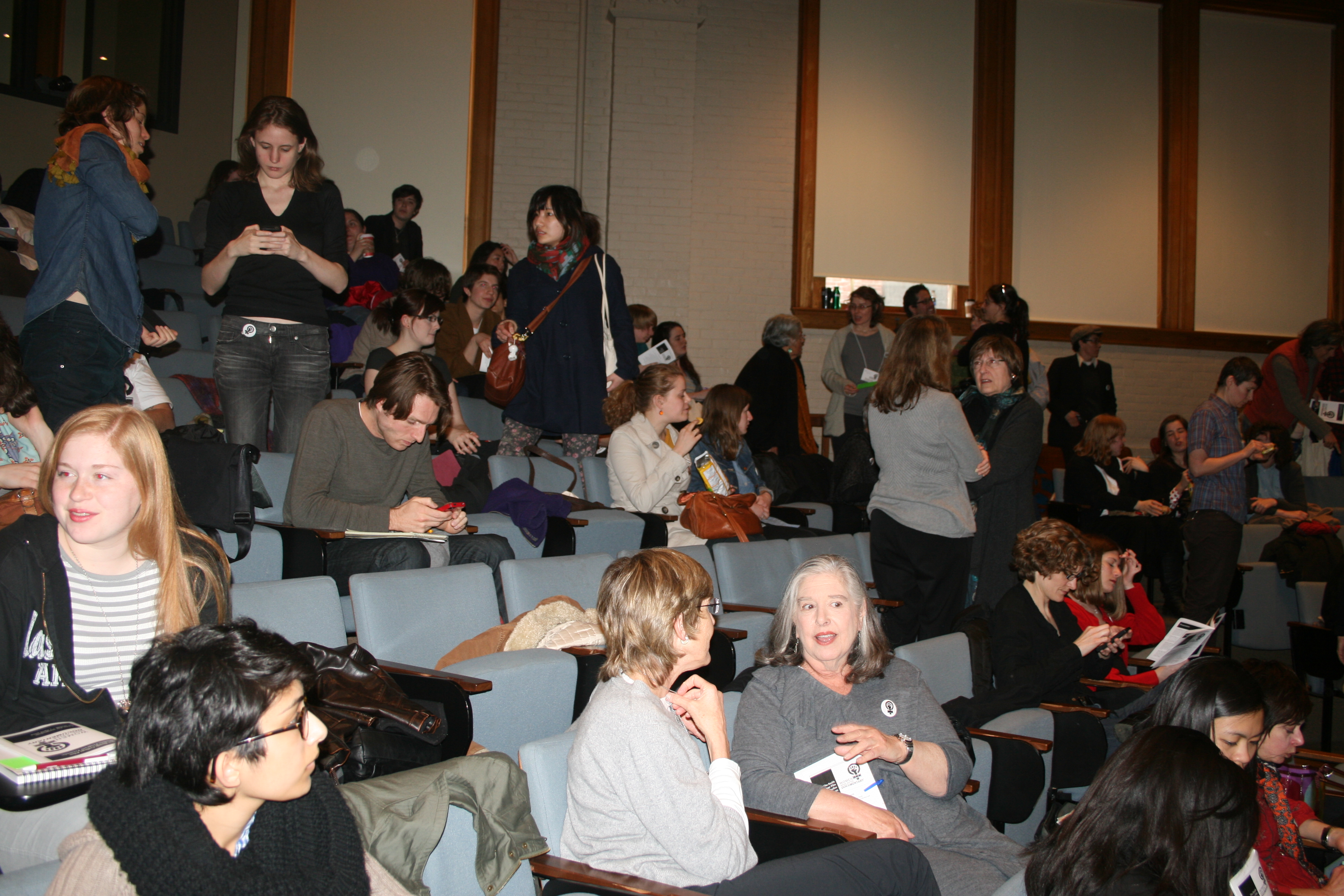
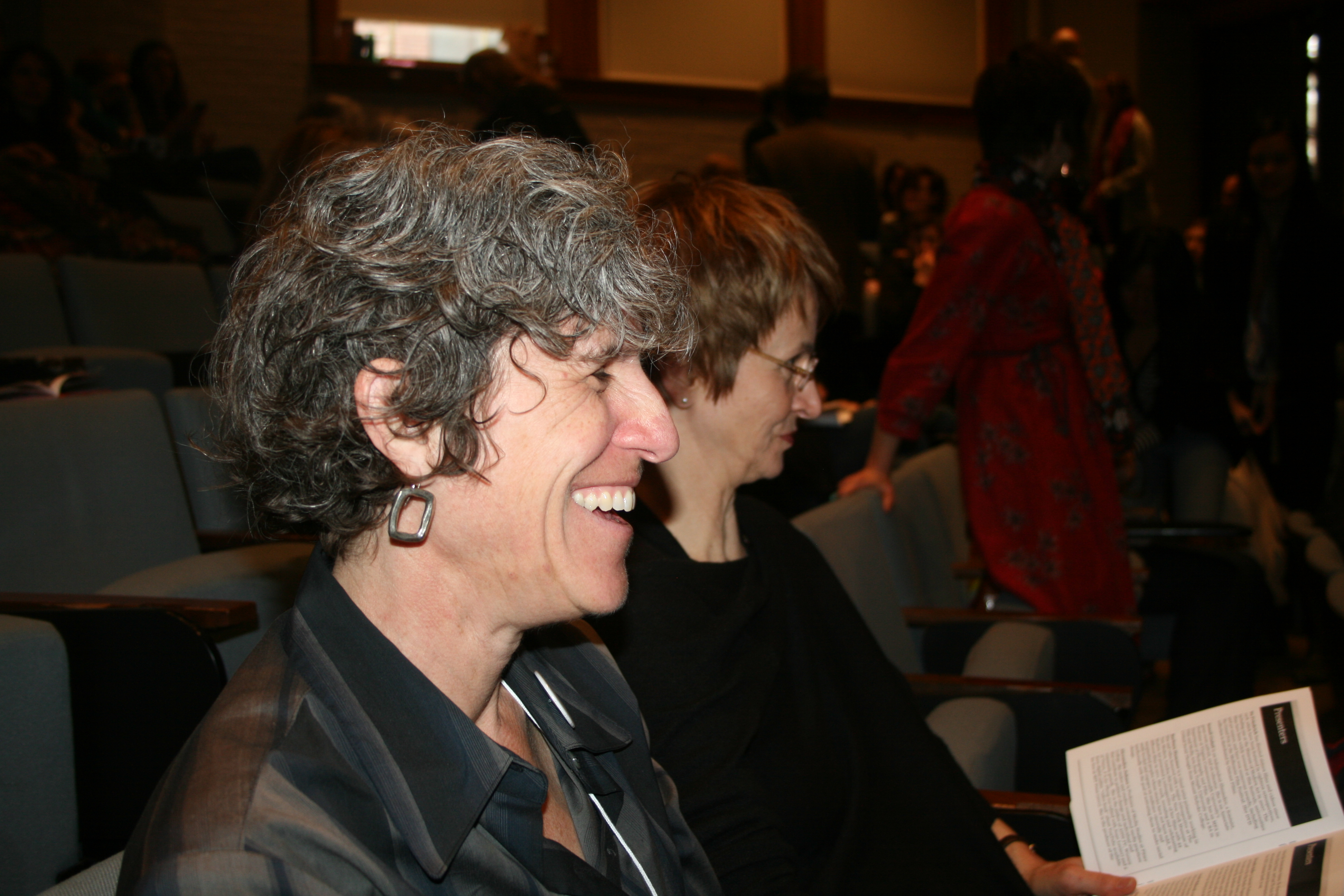
So far (and this is the early stages) working together on this project has been fun, allowing us to actively employ many of the reciprocal skills and interests that brought us together in the first place. Going to the Conference on Women, Social Justice and Documentary at Smith College (Northampton, MA) was an obvious activity for us to do together–but it did not seem so obvious until we’d been at the conference for almost an hour–– when it all began to fall into place.
It was a room filled almost entirely with women–often quite angry women, who had not such nice things to say about the field of American documentary as a male-dominated industry.  Who knew? (Well almost everyone on the room except yours truly.)  I guess I assumed–or wanted to believe––that documentary as a left-wing formation had really changed back in the 1970s and we had made slow but steady progress ever since.  Maybe I had spent too much time with Barbara Kopple, Deborah Shaffer and Alexis Krasilovsky in my youth?  Or Jane Gaines, Laura Poitras and Zareena Grewal more recently?  I had wanted to think that documentary practice was one of those limited arenas in which gender equity had been largely achieved. Not surprisingly, the women in my course, Documentary Film Workshop, knew better and at our first post-conference meeting echoed much of what I heard this past weekend.
At first it was a room full of angry strangers–but then familiar faces began to appear–like that of Alex Juhasz.   We overlapped at NYU and shared an interest in documentary praxis, even though  my work had been in film while she was a new media maven working in video. It was a generational difference, among several others.  Of course now our situations are reversed in that Alex is the master blogger and has a flourishing multimodal career while I am doing my best to catch up as I follow timidly in her footsteps. Alex had covered this conference on her blog Media Praxis: Integrating Media Theory, Practice and Politics long before I had even gotten started.

After the usual preliminaries, the conference opened with a presentation by Smith graduate Cynthia Wade whose film Freeheld (2007) won an Oscar for Best Documentary Short.  It was my first encounter with Cynthia and her work, but I had been alerted by my Yale colleague Margherita Tortora––a Smith graduate who teaches courses on Latin American film. Margherita had met Cynthia a few weeks earlier and urged me to bring her down to Yale.  Now I understood why.  The excerpts of her films were powerful, and she was an inspirational speaker, offering advice to students and the many young women in the audience who were in the early stages of their careers:  These women should become professionals with a craft, so that they could make a living as a cinematographer or editor.  For many years Cynthia was hired because she was “a vagina with a camera”–not even a skillful vagina with a camera–just someone who could go into situations where only women could go.  Sobering.

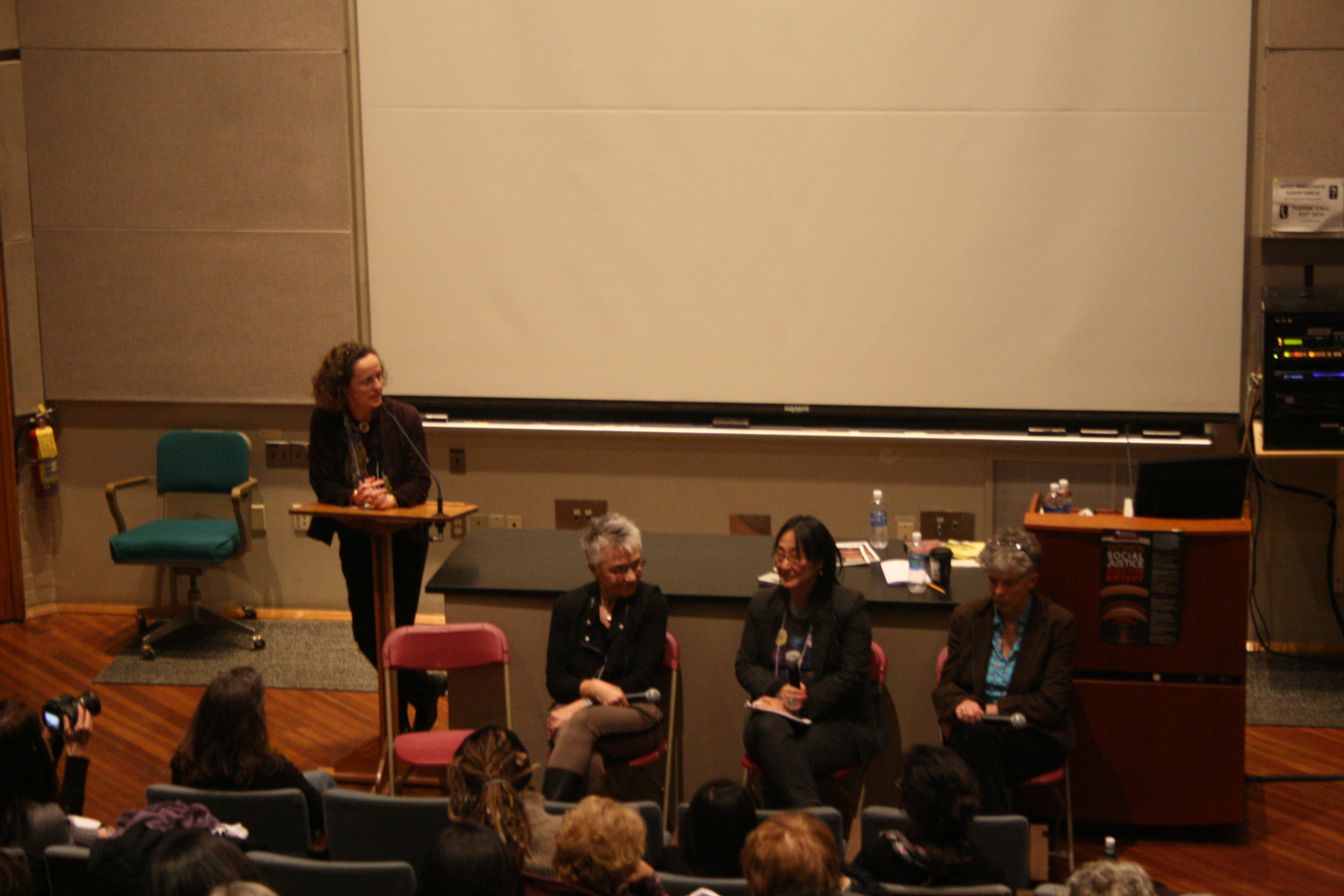
The first panel consisted of three veterans of the documentary scene who generally work in nonconventional modes: Su Friedrich, Barbara Hammer and Rea Tajiri.

Robin Blaetz moderates panel with Barbara Hammer, Rea Tajiri, and Su Friedrich

Obviously this was a group of veteran heavyweights, and it was a pleasure to get tastes of their recent work.  Friedrich showed a piece of From the Ground Up (2008), about the coffee business and the long chain of exploitation that makes it possible to buy a cup of coffee from a New York street vendor for 50¢. This was followed by Seeing Red (2005), for which Su has offered the following description:

In Seeing Red, three elements run parallel, overlap, diverge, lock horns and in various other ways give voice to the notion that a color, a melody, or a person has multiple characteristics that cannot be grasped by, or understood within, a simple framework. One element is purely visual. One is very verbal and minimally visual. One is purely musical. So is red the color of a fire truck or a ruby, of rust or a rose, of blood or a brick? How fixed is a melody if it can be twisted, stretched and shaken to the point where we no longer recognize its original form? And when we “see red,” what color is that exactly? What aspect of passion are we feeling? Are we looking outward and seeing injustice and cupidity, or looking inward at our own limitations and failings?

Friedrich took issue with the term “experimental documentary” as it is applied to her work.  Although her films fools around with the real world, it is the real world she shows.  “I don’t want the term ‘experimental documentary’ –just documentary,” she said.  Ok Su.  Next time I teach Contemporary American Documentary (post-1968), I’ll show one of your films!

Barbara Hammer showed clips of some early militant lesbian work and then some footage she had recently shot in Palestine.  Projection problems meant that somehow only part of the image for this latter work got on the screen, but it was powerful nonetheless as we see and feel the ways in which ordinary Palestinians are essentially trapped in a vast outdoor prison. Rea Tajiri showed a variety of clips from recent works in progress.  In one long scene, she follows her mother as she wanders around a nursing home, going in a circle.  Early in the scene she encounters a display of photographs, including a snapshot of her with Rea.  When she completes her circular tour of the facility, she again encounters the display board: When Rea shows her the same photo, she encounters it as if for the first time.  A slow, memorable and very painful piece.

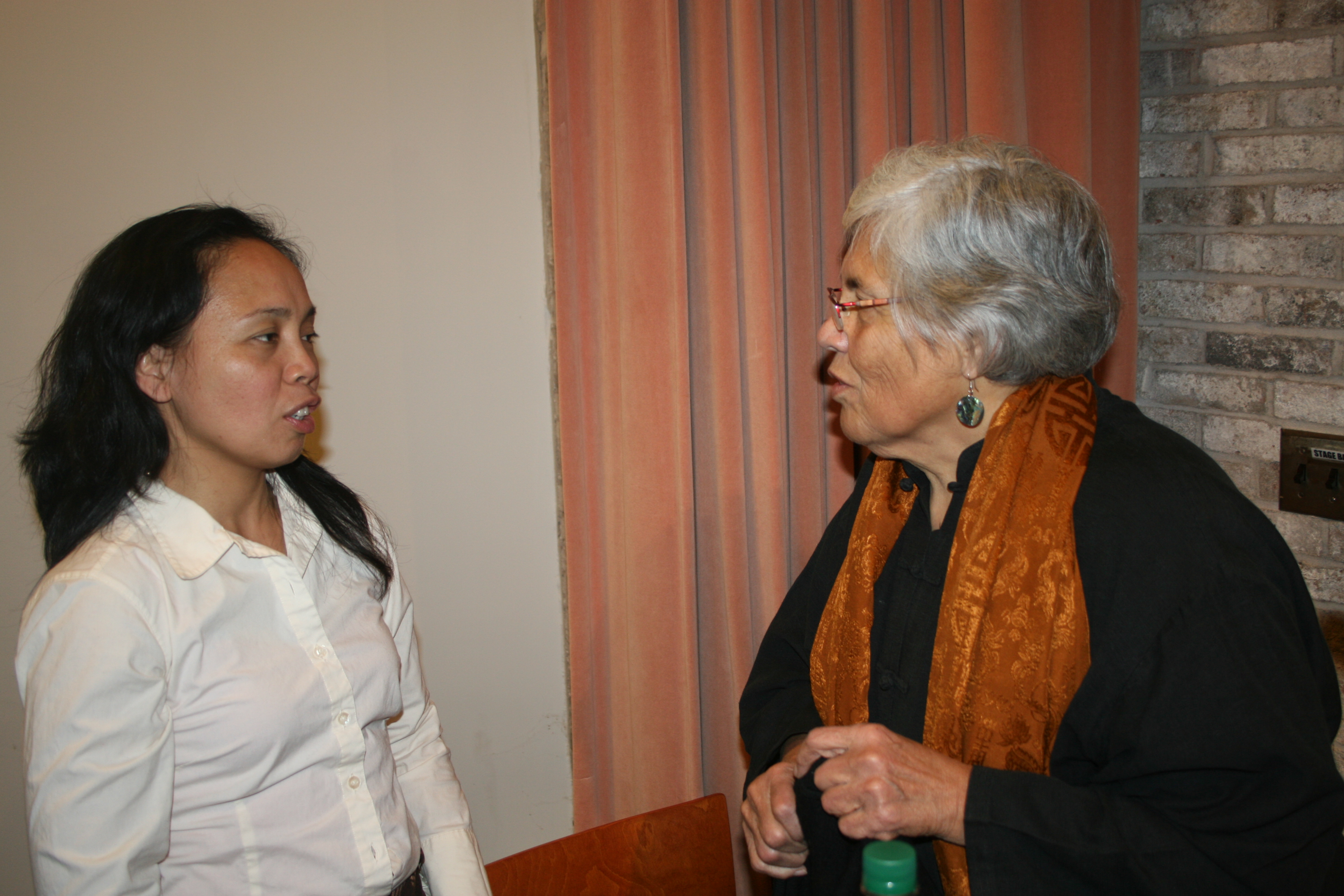
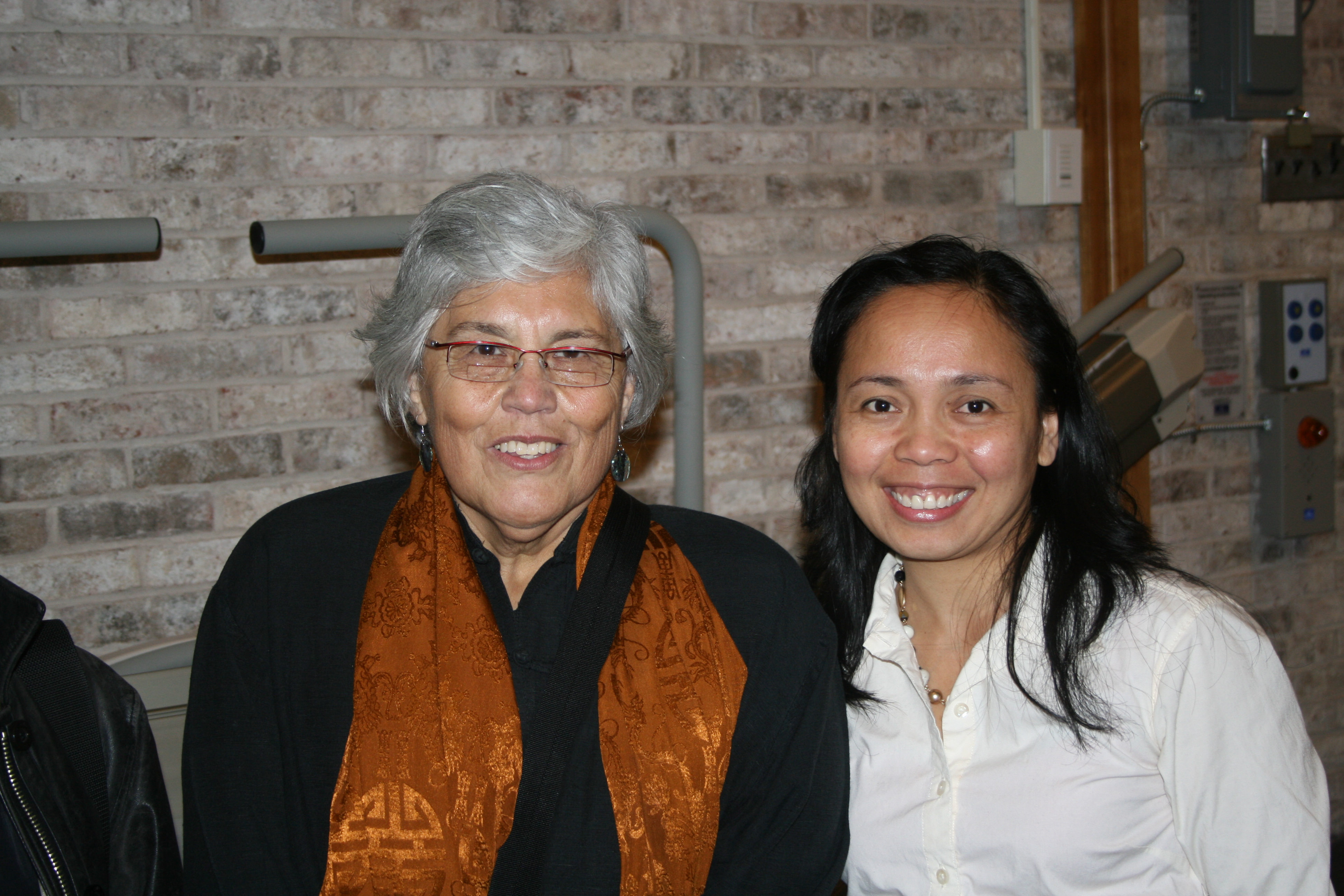
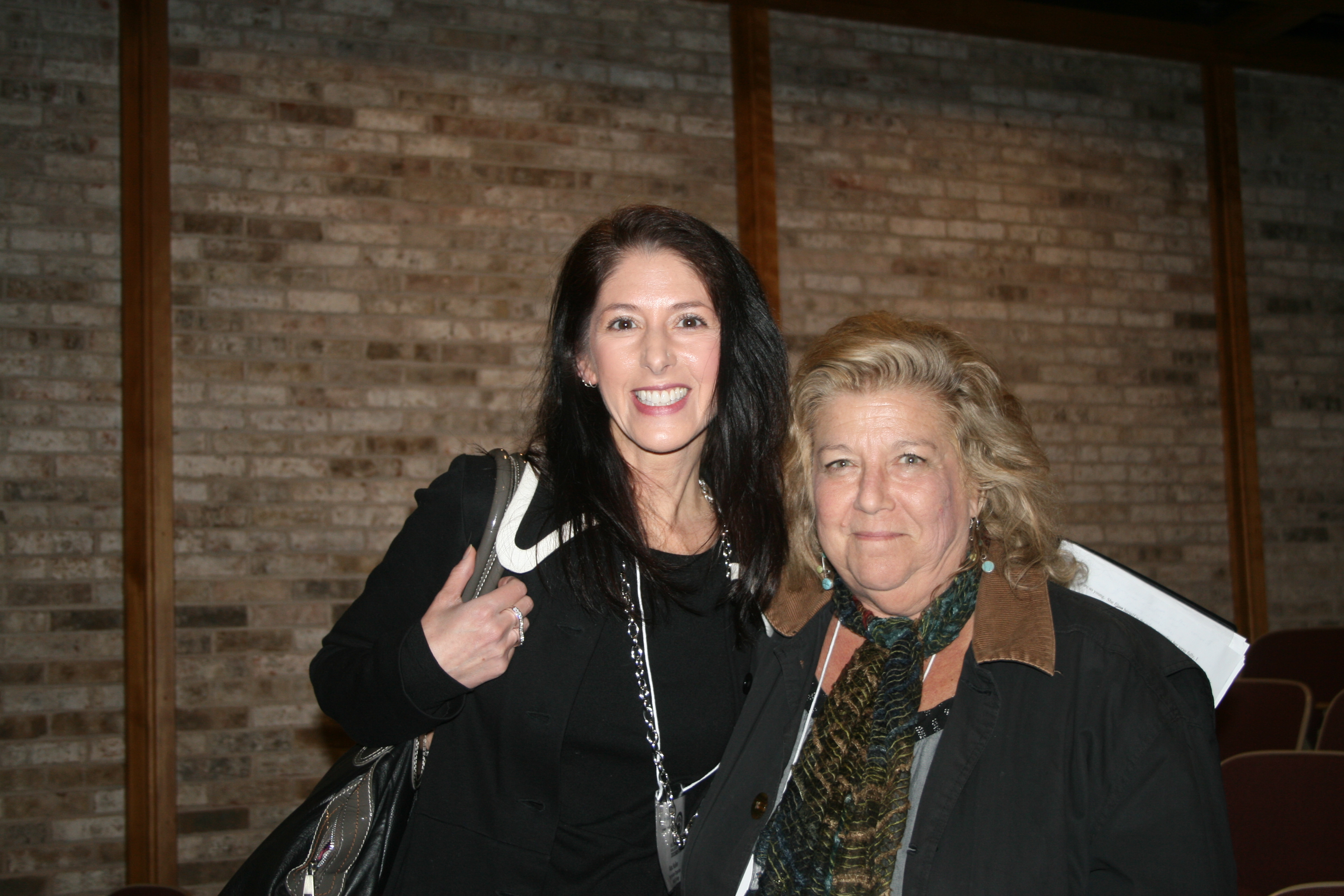
The keynote speaker was Lourdes Portillo, who showed a section of Señorita Extraviada, Missing Young Woman (2001) and talked about the process and problems of production. This included the dangers: how one day when she was in Mexico, a stranger made clear that the film had put her and her family in danger–he knew where they lived. Afterwards I said a brief hello, but Threese–who was no stranger to the dangers of extra-judicial killings when in the Philippines––felt a powerful connection.  Soon I was taking their picture and in a brief period of time, they found another connection: Lourdes has a Filipina daughter in law (making them life-time Facebook friends).


Threese and I then had dinner with Holly Fisher, a friend of mine from long-ago. As the conference began, Holly sat down across the aisle from me: we barely recognized each other!

The glorious Holly Fisher

The time chasm was quickly bridged.  We had gone through the NYU Cinema Studies program together in the late 1970s and early 1980s.  I remember the day when one of our fellow classmates––someone plugged into the downtown art scene––casually informed me that Holly had become the nation’s foremost experimental filmmaker. Hmmm.  She also cut Who Killed Vincent Chin? (1988), a film I love, have written about, and often teach.  Holly and I recalled our shared experience as filmmaking professionals trying to make sense of film theory as taught by Noel Carrol–a bonding experience if there ever was one.  Holly, who recently moved from New York to the Five-College area, had just come back from the Environmental Film Festival in the Nation’s Capital, where she showed her latest film: Deafening Silence (2012).
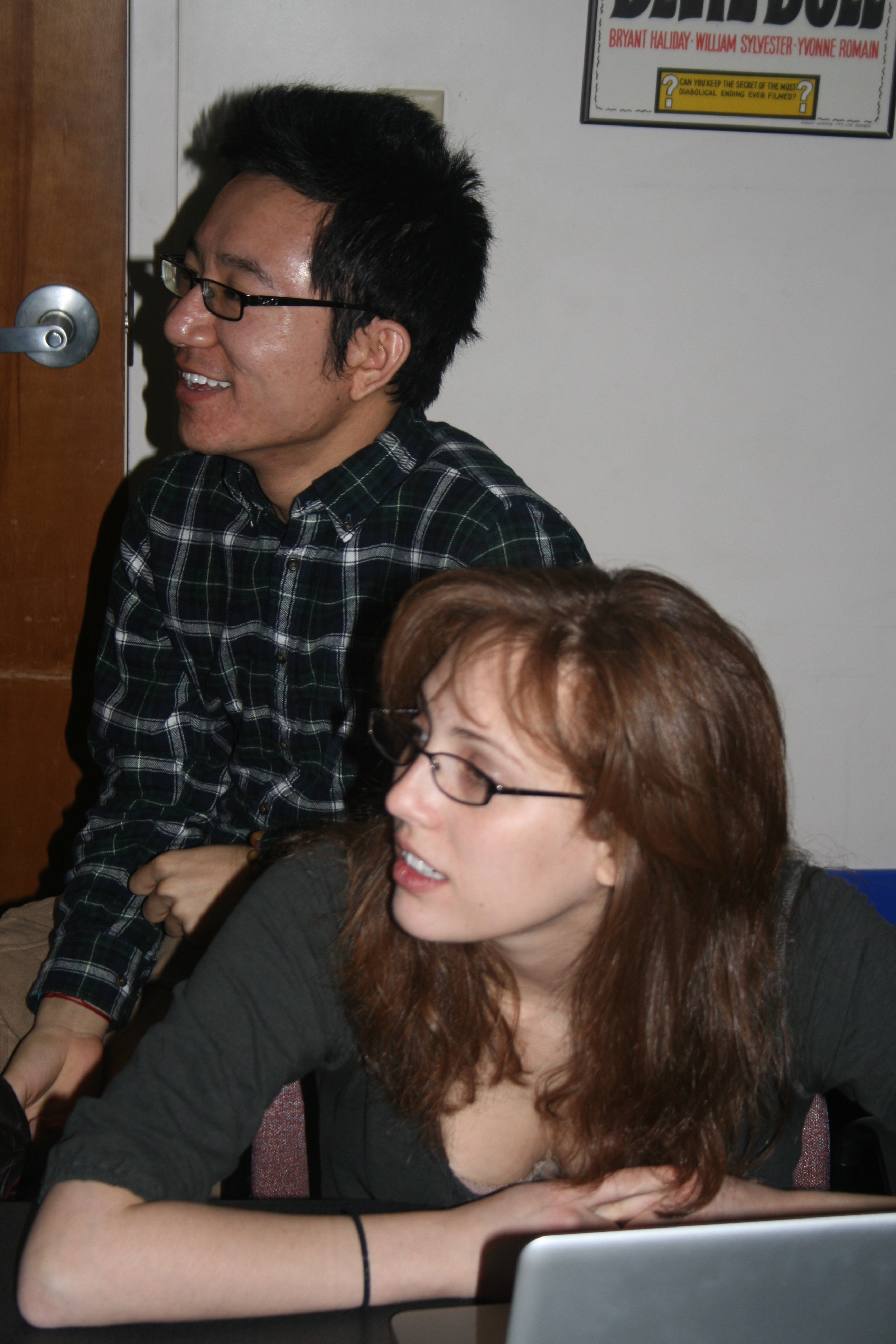
The next day, as Threese and I returned, it was to a room good friends. On this second day, the younger, still emerging generation held the stage–though in many respect these women documentarians were closer to mid-career.  Liz Miller presented several excerpts.  The first was from her documentary short Novela, Novela (2002), which examines a soap opera series that was made in Nicaragua and dealt with serious social issues.  The Water Front (2007) looks at the privitization of the water supply in a small American city, where residents receive water bills totaling thousands of dollars. Finally there was Mapping Memories, “a collaborative media project which uses personal stories and a range of media tools (video, sound walks, mapping, photography) to better understand the experiences of youth with refugee experience in Montreal.” This project has been developed in partnership with the Canadian Council for Refugees and Montreal Life Stories and I was happy to put Liz in touch with our friends at IRIS – Integrated Refugee & Immigrant Services––in New Haven.

Next up was Alex Juhasz.  I had missed her recent presentation at Yale due to an unavoidable conflict, so now I had a chance to make amends.  She spoke to a dilemma I seem to face almost everyday––the opposition to real praxis in the academe–at least in the Humanities.  As Alex noted, “institutional schooling confirms we are not authorized to ask world changing questions –and we are expected to either work as scholars or as artists, which others will write about.” Alex encouraged us to see the latest film that she produced––The Owls (2010), directed Cheryl Dunne––which is on Netflix, and then gave us a quick introduction to Learning from YouTube, her videobook published by the MIT Press. More generally Alex discussed her critical relation to the internet, as she seeks to bring “old school values” and principles to new media forms such as the Internet.

Sonali Gulati showed an excerpt of her autobiographical documentary I Am (2011), about her fraught relationship with her mother. I found it to be a beautifully crafted and thoughtful film. I was frustrated when the lights came up, 10 minutes into the film.

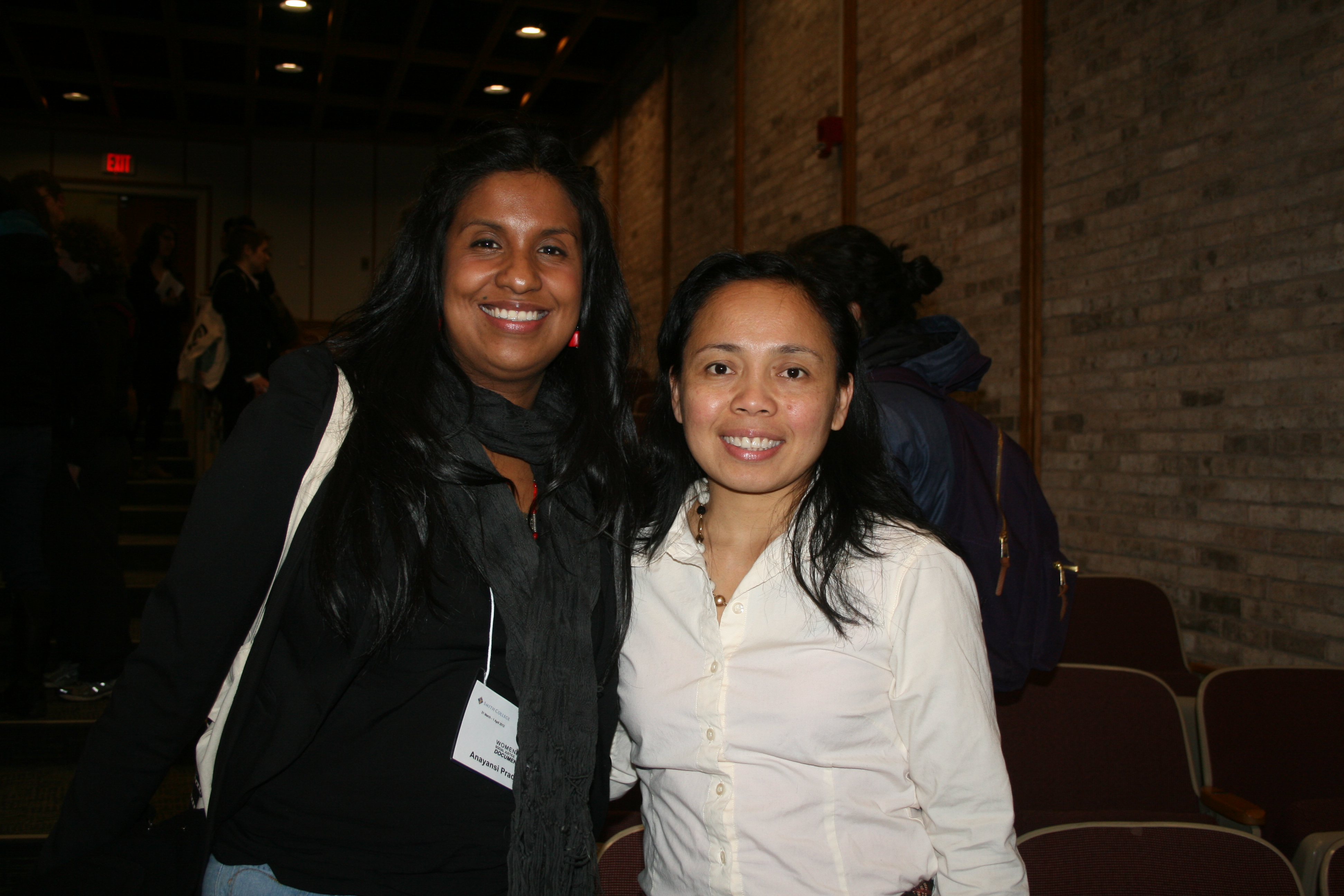
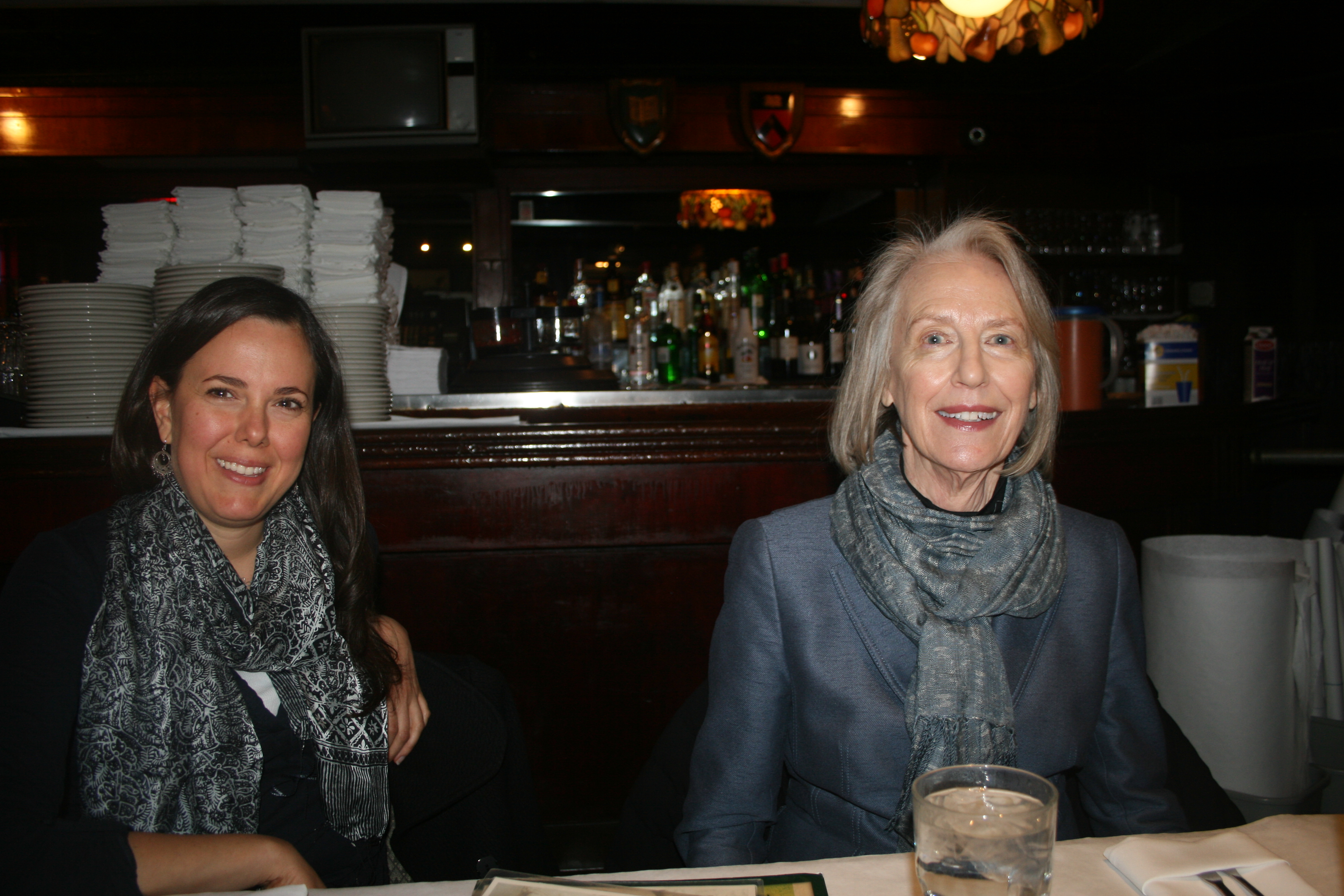
Anayansi Prado & Maria Threese Serana

The final speaker in this group was Anayansi Prado, who showed excerpts from three of her documentaries, all of which are about topics that touch our lives and/or the lives of people in our film-in-progress. Maid in America (2005) focuses on the lives of undocumented workers in Los Angeles.  Children in No Man’s Land (2008) “uncovers the plight of unaccompanied immigrant minors entering the United States.” Paraiso for Sale (2011) looks at the influx of American retirees into Panama, where they acquire waterfront properties, displacing local residents.  Her current project is working with grassroots groups so ordinary people can use video to document their lives.  By this time Anayansi and Threese had spent the morning together, bonding and talking about some possible future project on which they might collaborate. Anayansi is from Panama and came here when she was 13 with her mother and an American stepfather, who had worked in Panama.

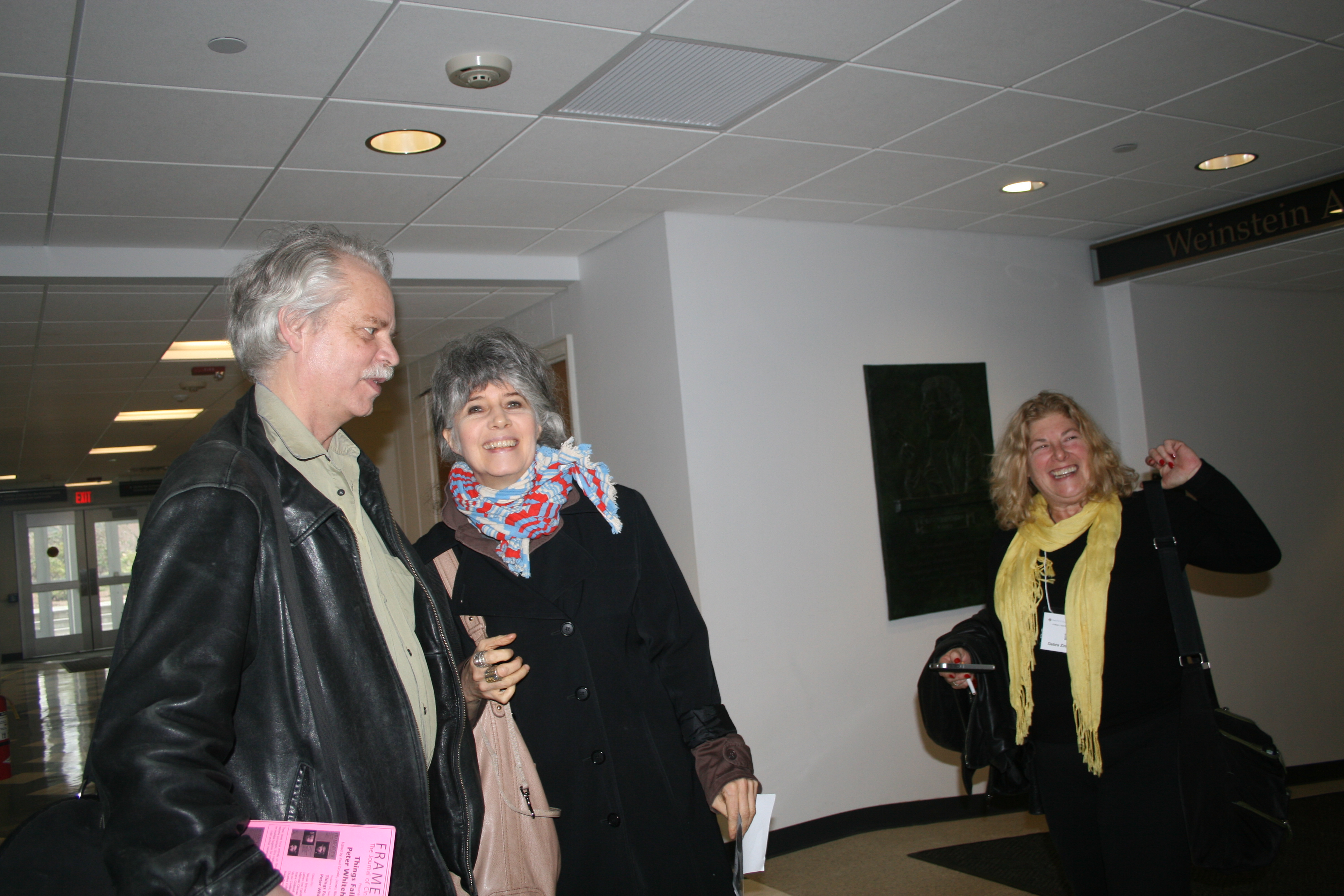
Finally Debra Zimmerman talked about the history of Women Make Movies, which is now 40 years old: how she had reorganized it, and how it has survived and flourished even as its distribution formats have migrated from film to videotape to DVD to online streaming.  Another account of that history can be found here. Afterwards there was the usual picture taking:

With Drake Stutesman and Debbie Zimmerman

Alex Keller and Joan Braderman


With Amelie Hastie

As the conference concluded Threese and I arranged to videotape a quick interview with Anayansi Prado; then we all went to a late lunch at the nearby home of Alexandra Keller, director of Smith’s Film Studies Department.  Alex organized the conference with Bernadine Mellis, a Five College Visiting Assistant Professor of Film Studies.


Waseda Film Studies Comes to Yale-with Jet Lag
Posted by chamus on April 2, 2012
Posted in: Uncategorized. Leave a Comment

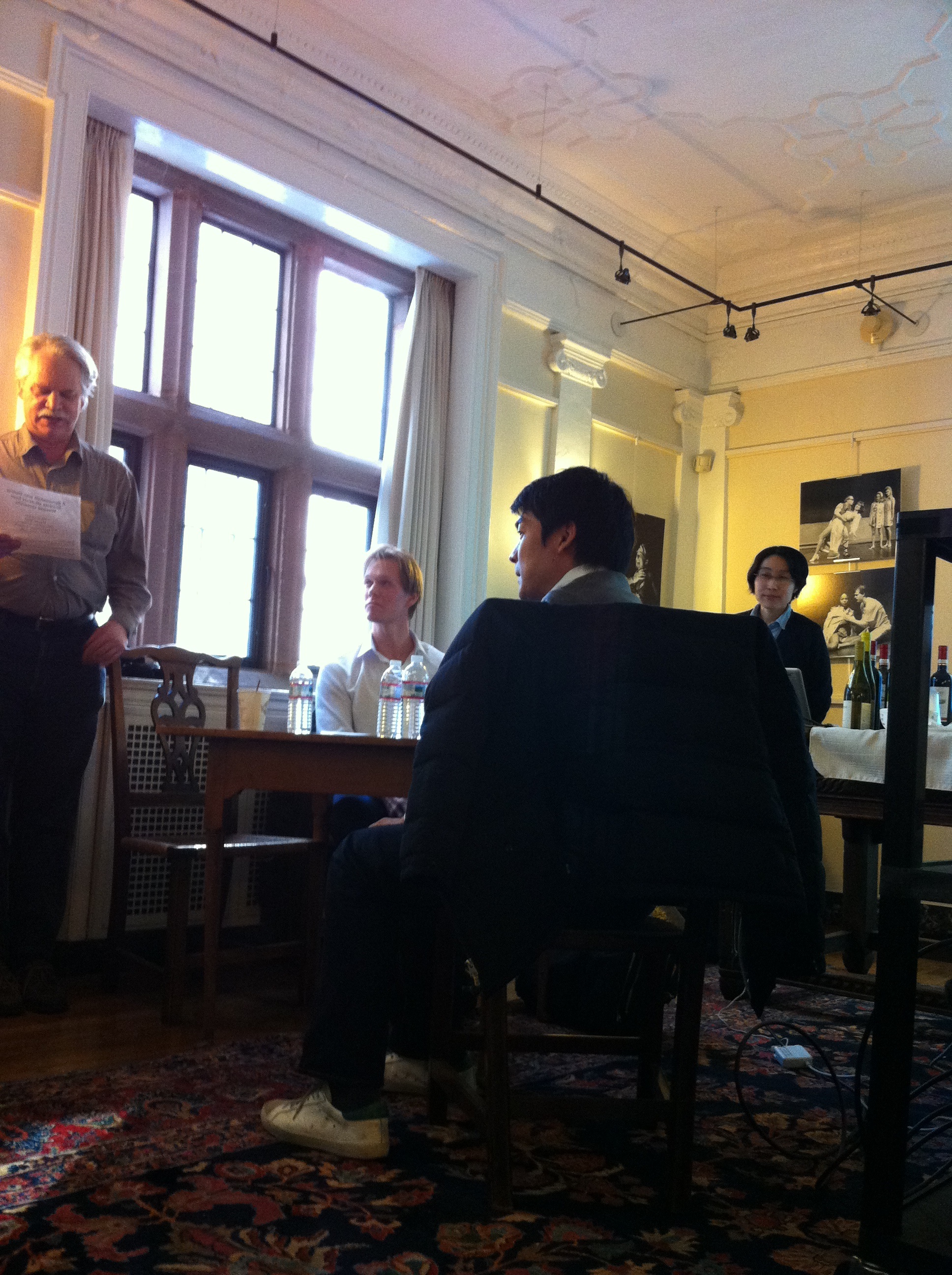
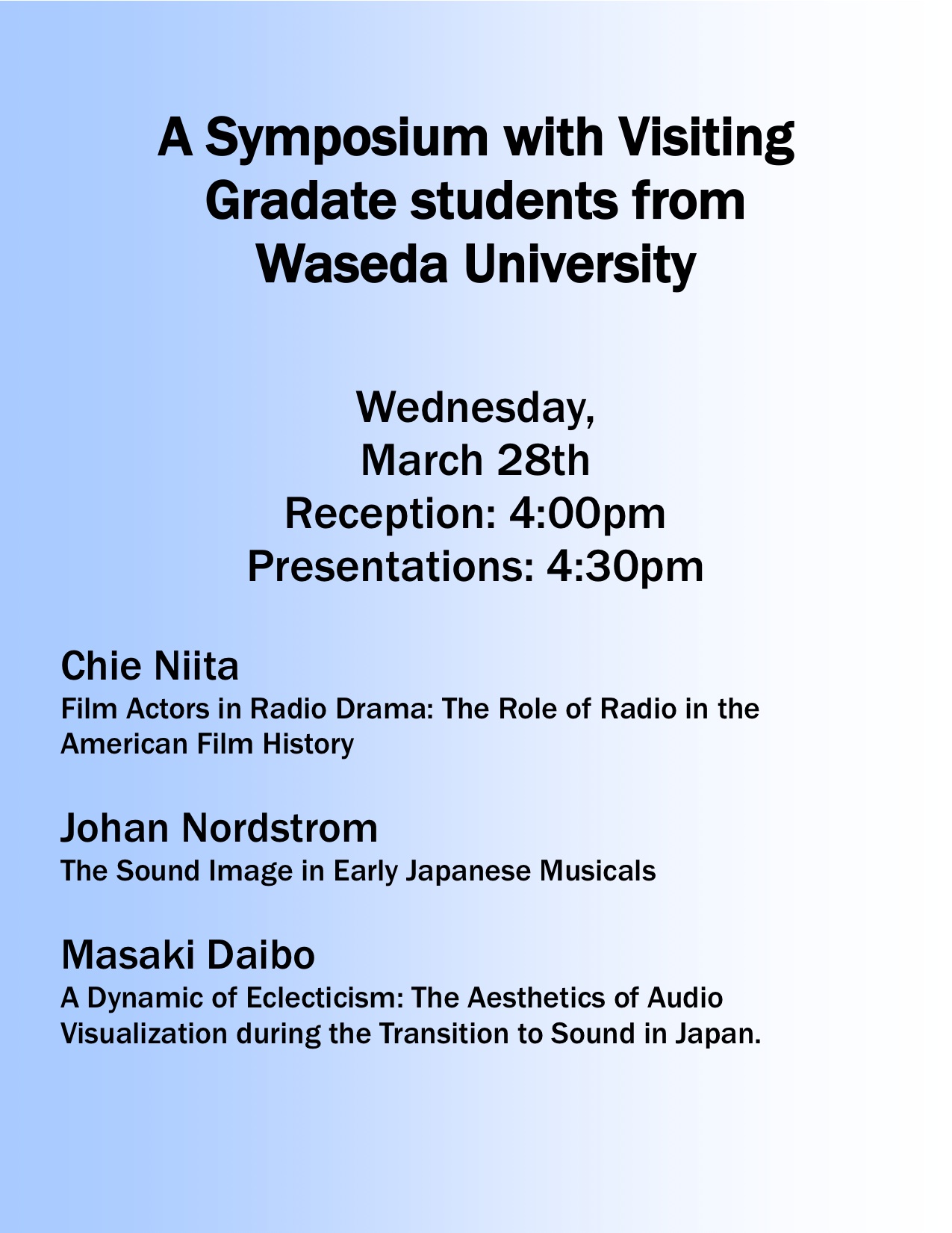
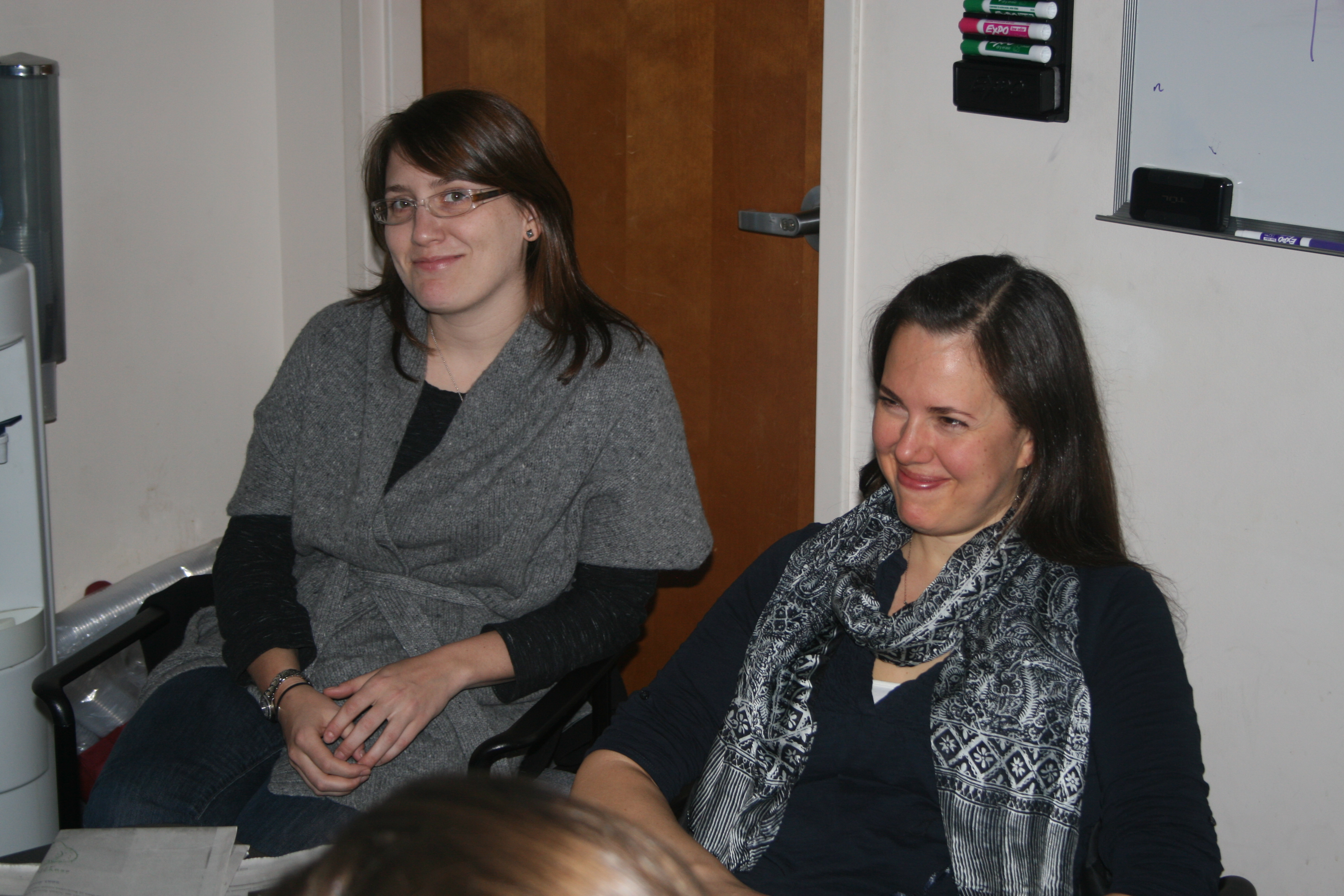
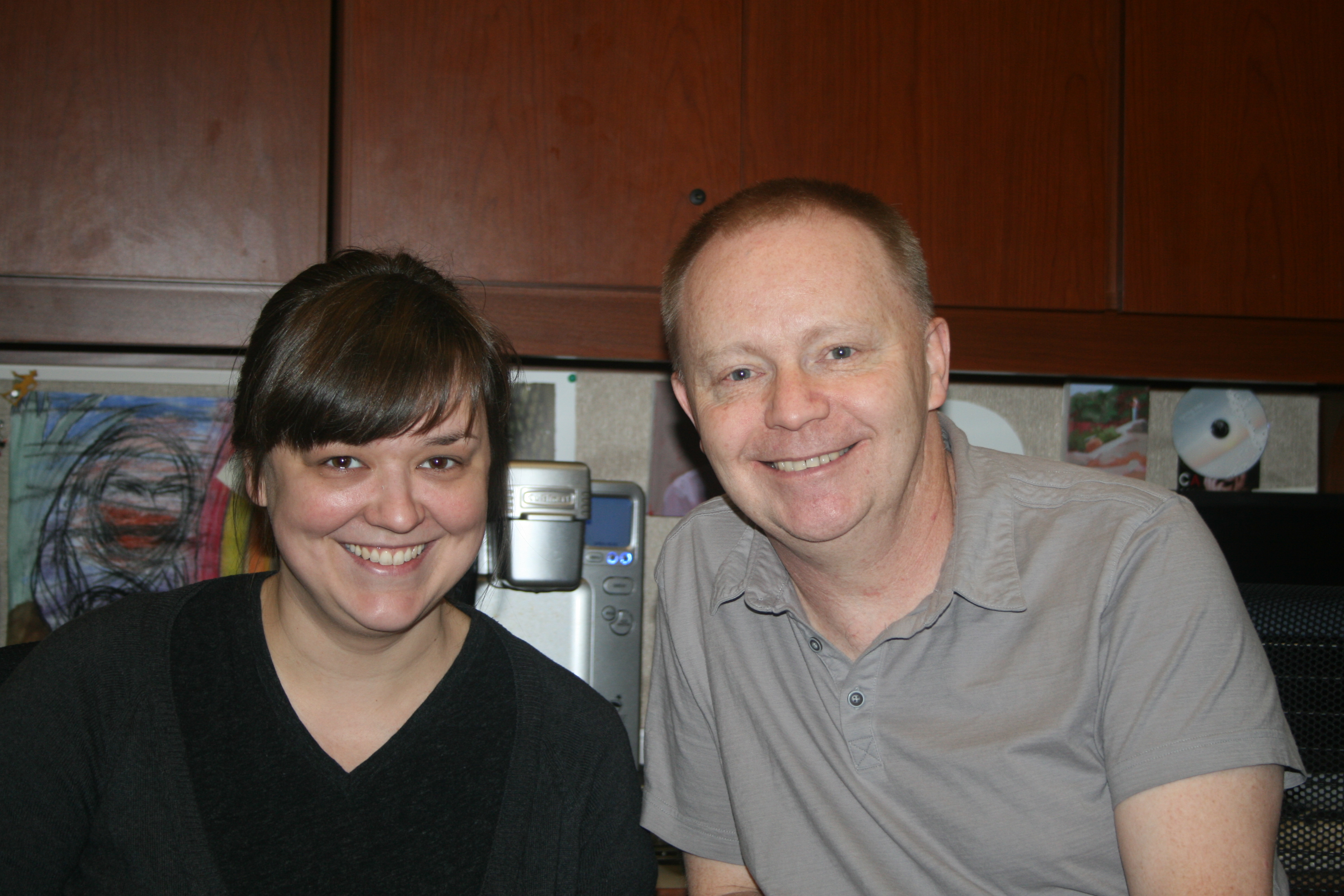
In an earlier posting (Back in Japan: A Conference on Acting––with Jet Lag), I mentioned that three graduate students from Waseda University (Tokyo, Japan) would be coming to Yale to present their scholarship.  The story in brief:  They would attend the Society for Cinema and Media Studies conference in Boston (March 21-25, 2012), but their university expected them to return home immediately–with no time to go sightseeing or do research. And no time to get over their desynchronosis (otherwise known as jet lag). It was subsequently so arranged that they gave presentations at Yale a few days after SCMS (on March 28th) buying them some extra time in the US.  Since DAIBO Masaki and Johan Nordstrom were reprising their SCMS papers, they headed to New York and did research at Columbia University’s library which has a very strong archive of Japanese film material.  NIITA Chie, who had been a pre-doc at Yale for a year, spent her time preparing a presentation on her recently defended dissertation.  Moreover, the resulting symposium provided an opportunity for Yale Film Studies graduate students to meet their Waseda counterparts––and obviously vice versa.
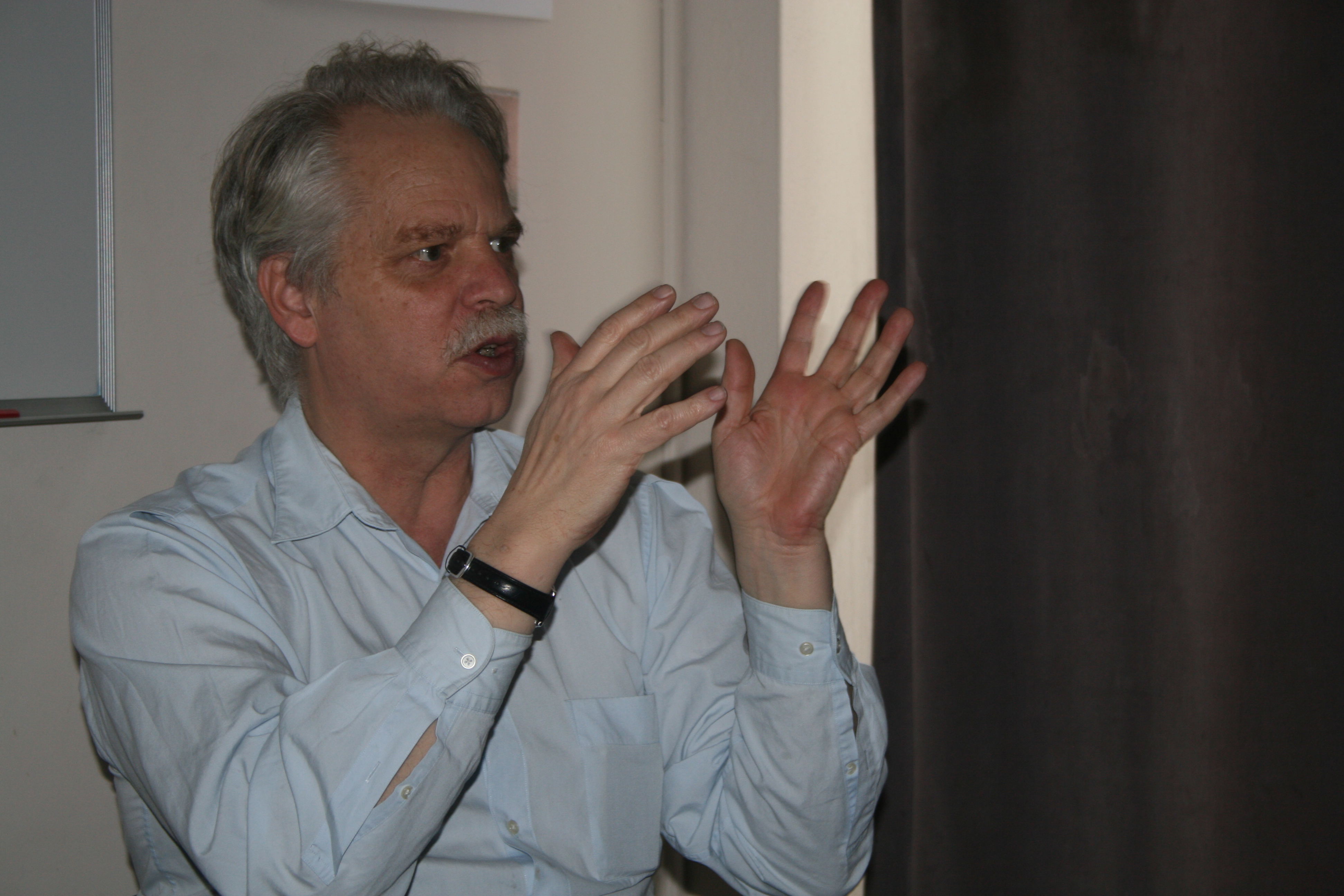
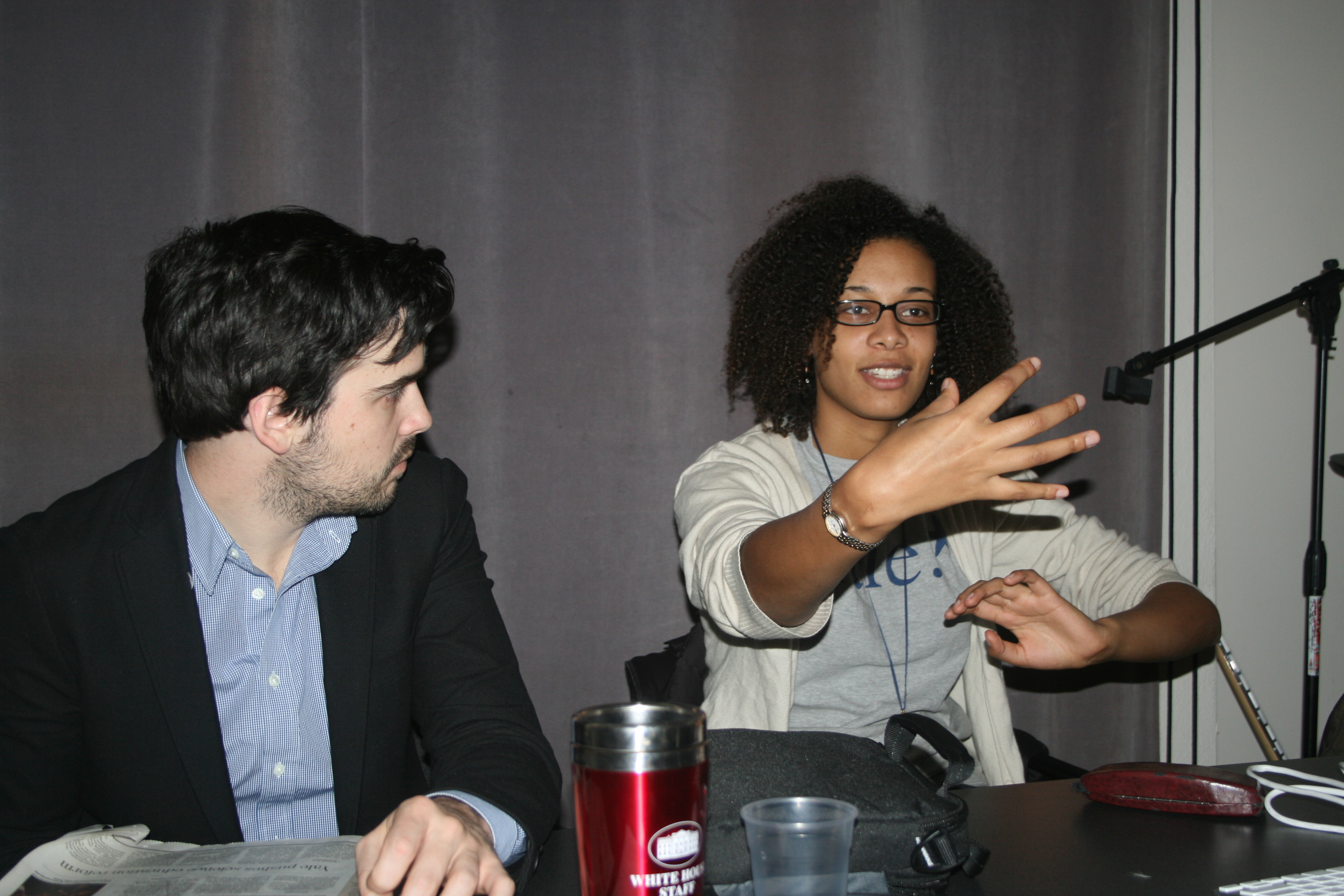
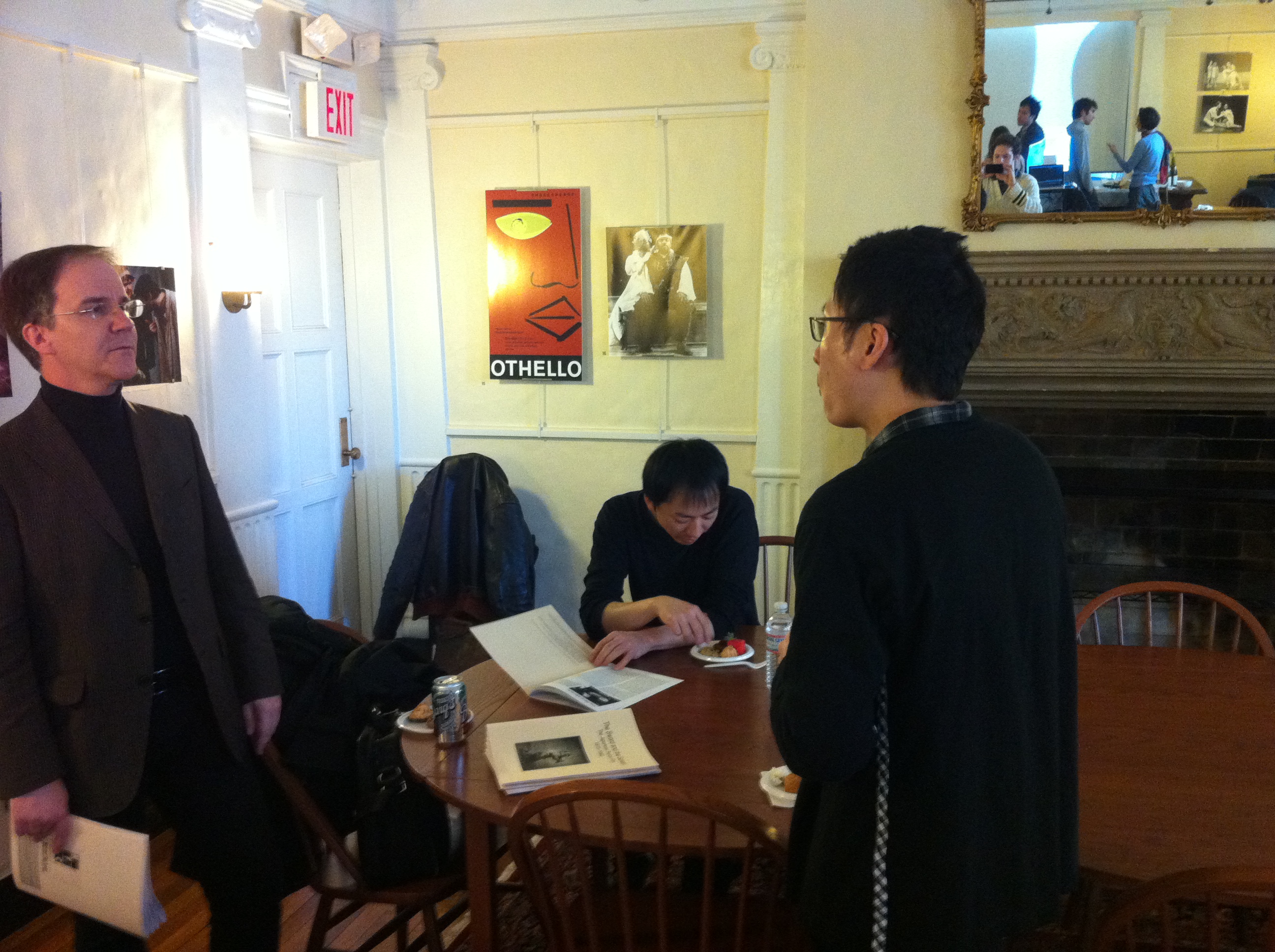
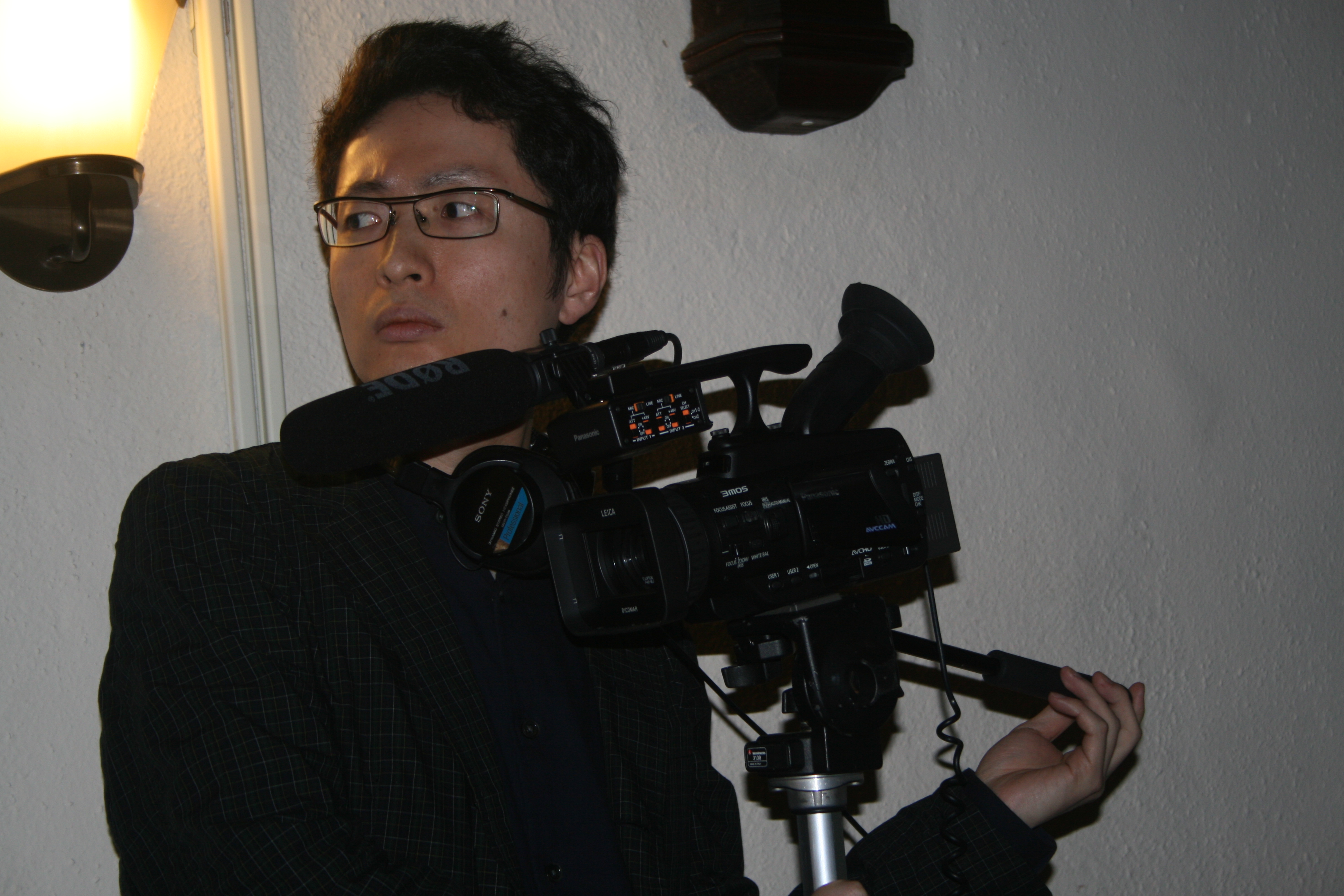
Introducing Johan Nordstrom, DAIBO Masaki and NIITA Chie

Here is the announcement for their presentations, which had a shared concern with the relation of radio and recorded sound to motion pictures:

I just want to report, in case their advisor KOMATSU Hiroshi reads this posting, that they did a terrific job.  It was a particular pleasure to hear Chie present an overview of her dissertation before focusing on a particular chapter dealing with Lux Radio Theater, which offered radio adaptations of motion picture dramas from the mid-1930s into the mid-1950s. Dr. Niita is quite independent and research is lonely work, so I was unsure how successful her previous year at Yale as a pre-doctoral fellow had been.  Clearly it was highly productive, and I felt very honored to have served as her sponsor.  The relationship between radio and motion pictures has been a seriously under-examined aspect of American cultural history: Chie’s strong dissertation should be translated into English and published.

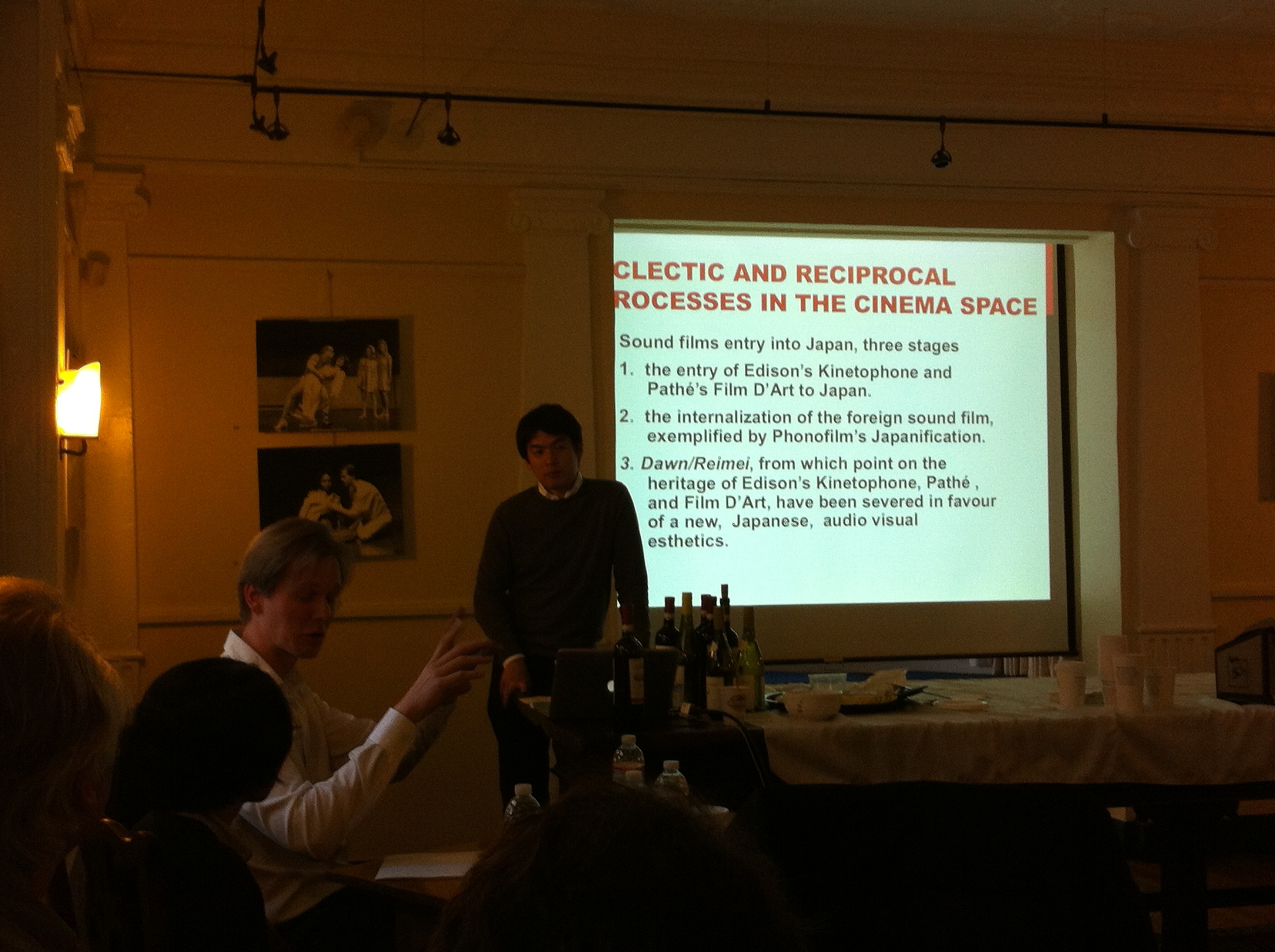
While Masaki presents, Johan offers a short interjection

Nordstrom’s exploration of the way records and songs were incorporated into silent Japanese cinema was a fascinating surprise, at least to this non-expert. His presence also reminded Yale students that Waseda has a graduate population that is as international as our own.  Daibo’s work on the long history of syncrhonous recorded sound in Japan took an original turn as he explored the ways in which successive waves of sound technology went through a process of Japanification.

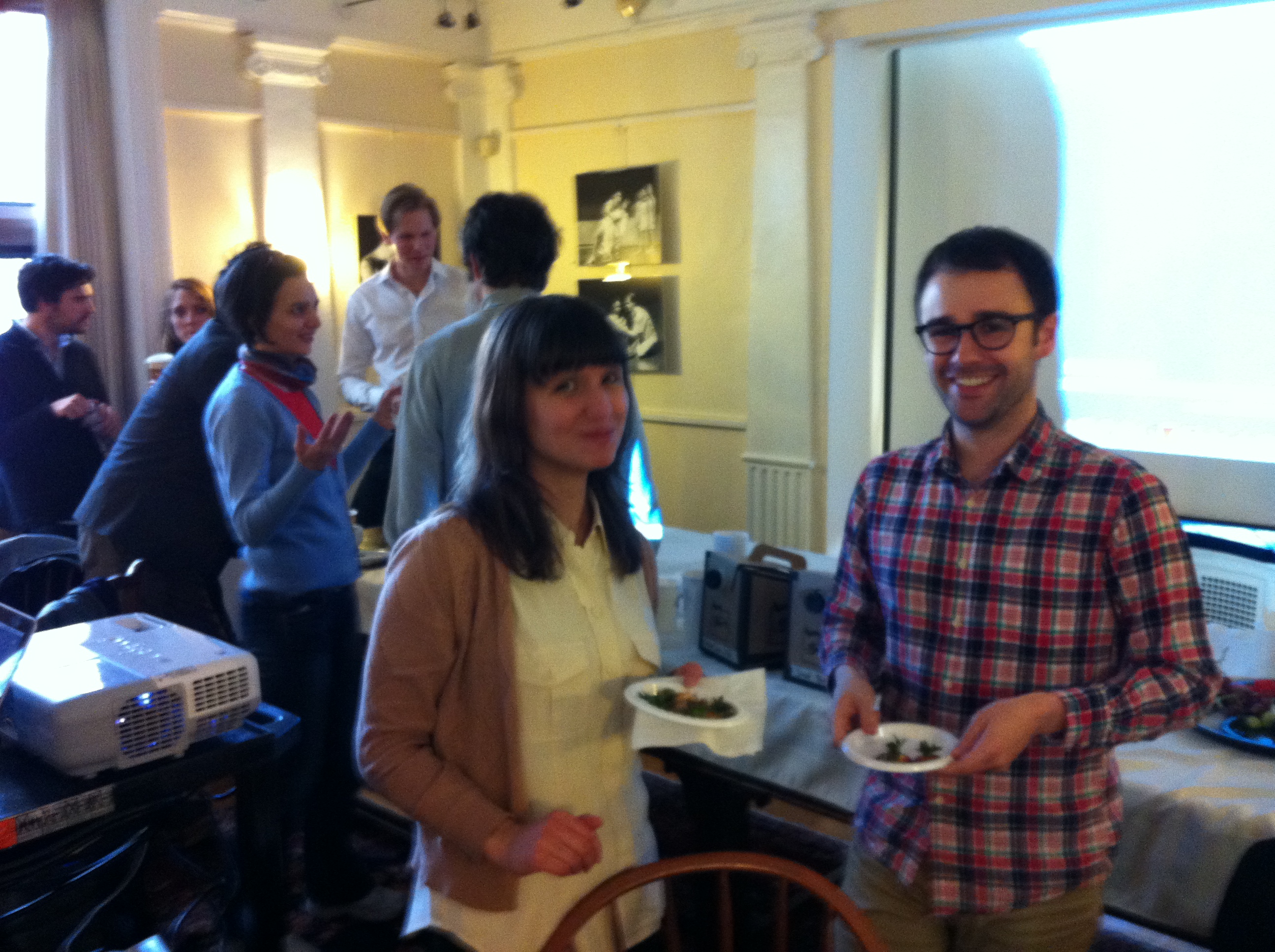
The symposium was embedded within a reception––coffee before the presentations, wine afterwards (well that was the idea, anyway).


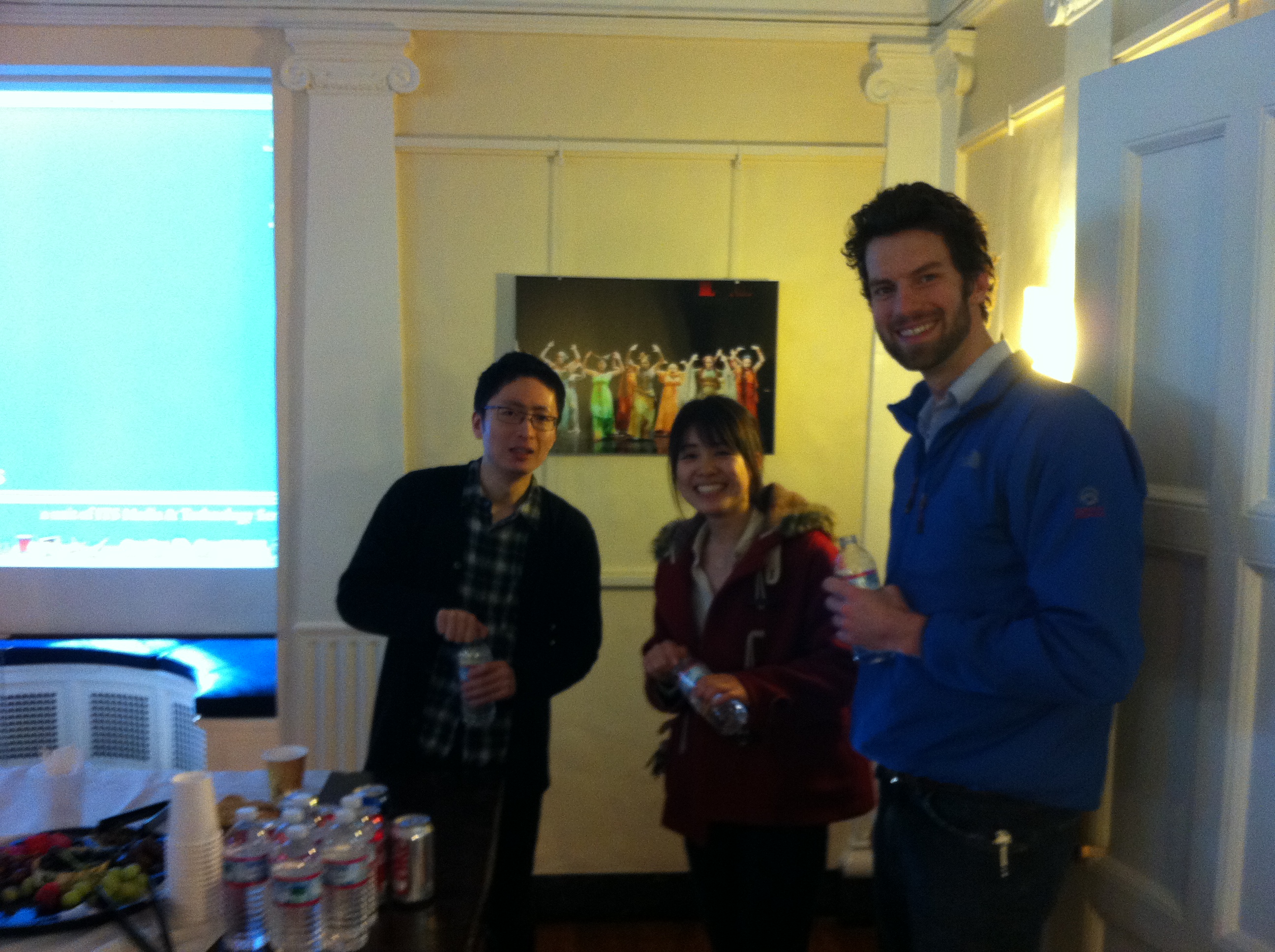
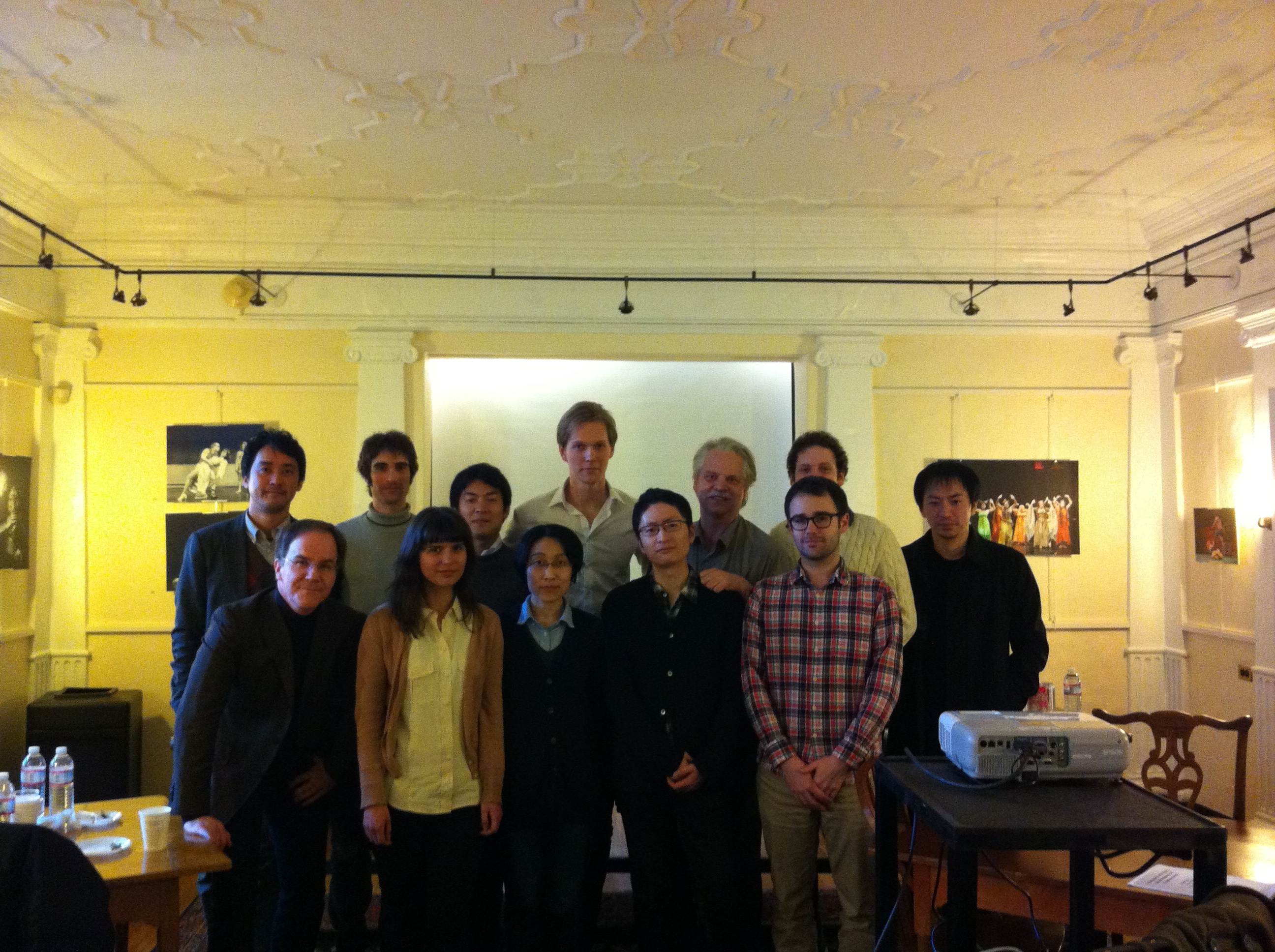
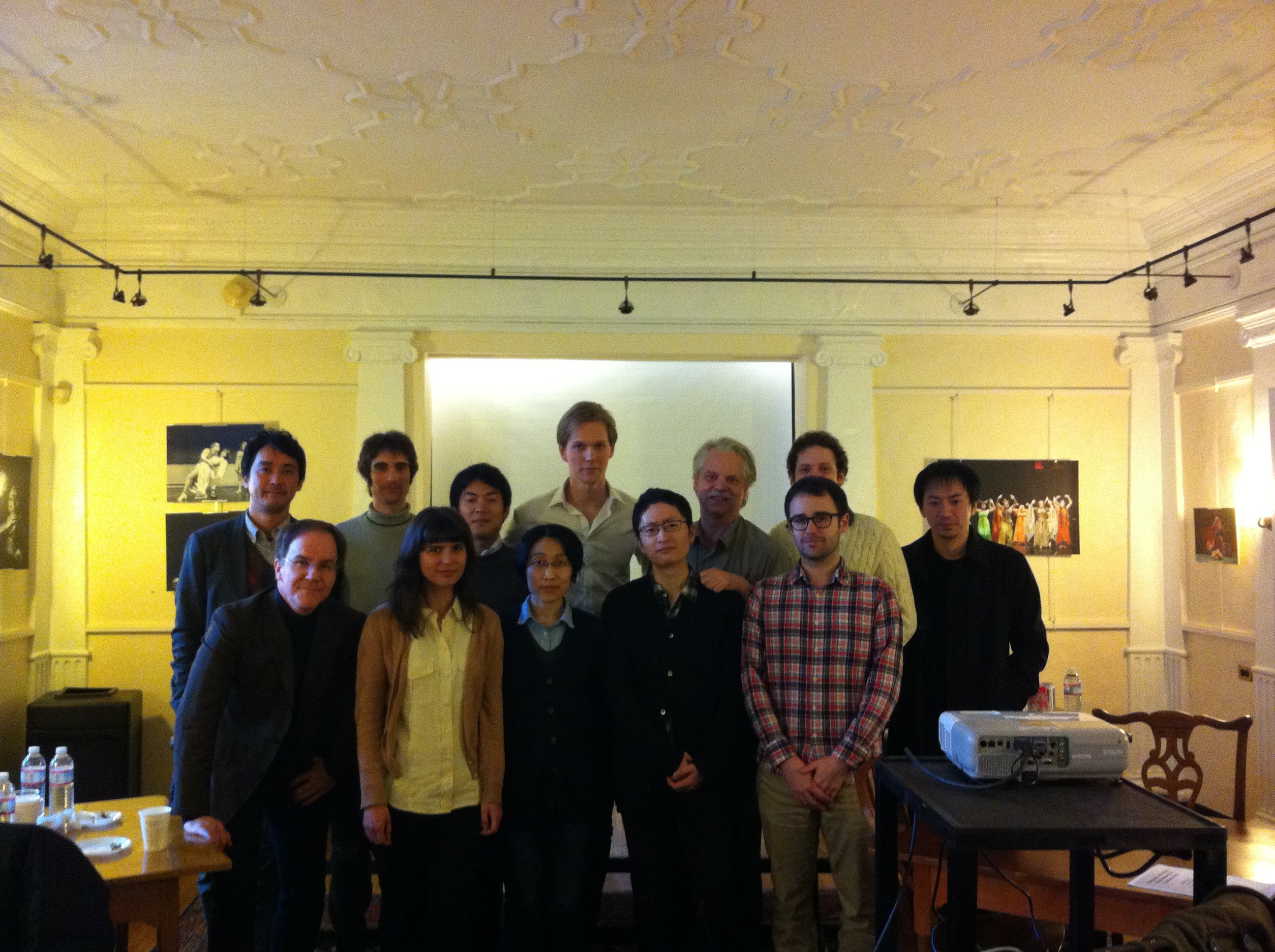
Someone at the symposium declared that Waseda has the foremost scholar of Japanese Silent Cinema in Japan (Hiroshi KOMATSU) while Yale has the foremost scholar of Japanese Silent Cinema outside Japan (Aaron Gerow). Admittedly, this comparison would seem to call for a final round of some reality TV show along the lines of  American Idol (tentatively names Academic Idoltry), but this meeting of their students simply ended in a friendly group portrait:

Waseda and Yale Film Studies United: A Group Portrait
Photos by Mal Ahern (standing next to Chie) and Josh Glick –(almost hidden behind Sam Good). Incidentally Sam provided Masaki with hospitality for a couple of nights.  So thanks go to Mal, Josh, Sam and above all to our administrative general  Katherine Germano, who organized the whole event.

Happy Birthday to Us-Part 2: A Community of Families Celebrates
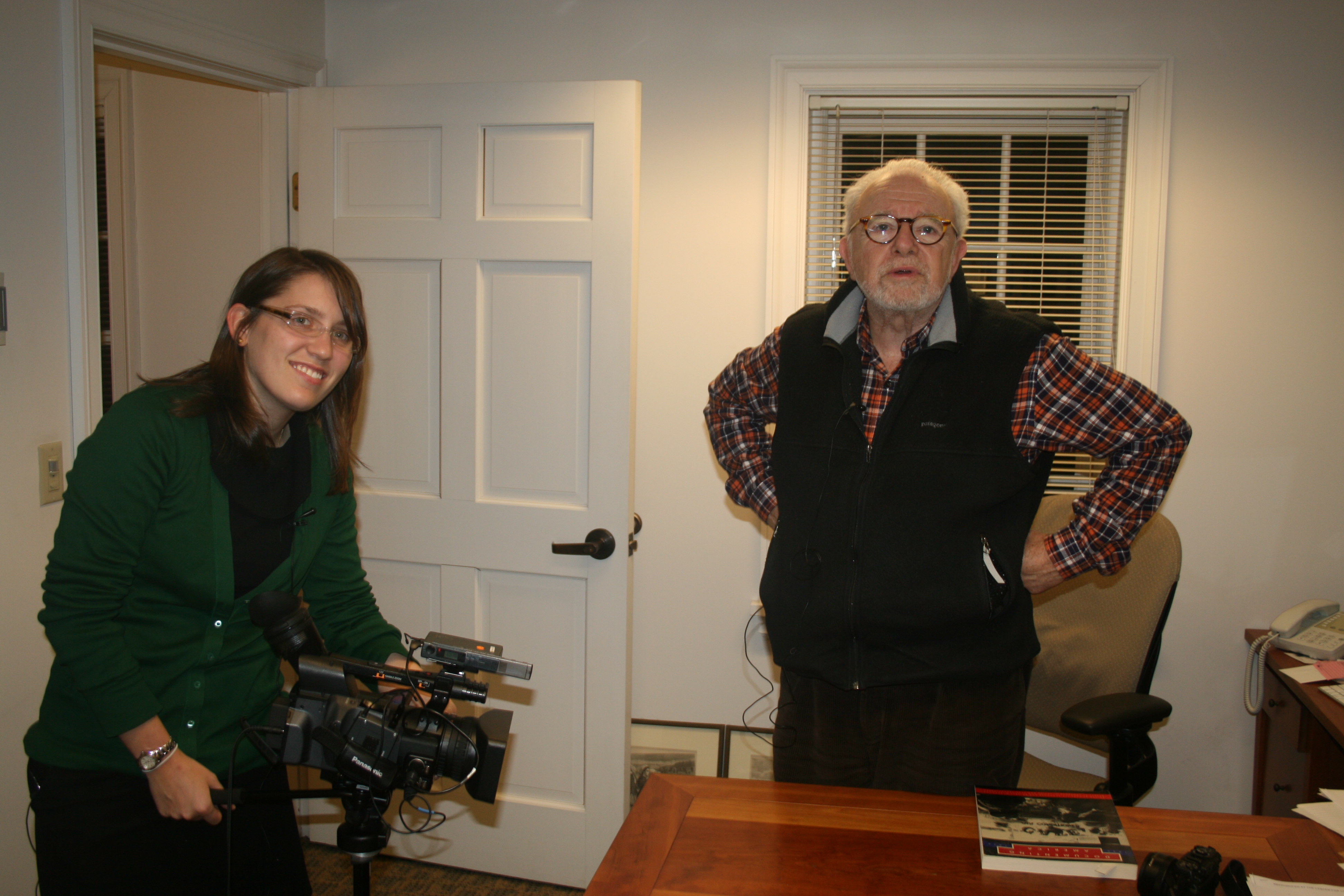
Posted by chamus on February 26, 2012
Posted in: Uncategorized. Leave a Comment

THIS POST IS ALSO UNDER CONSTRUCTION.

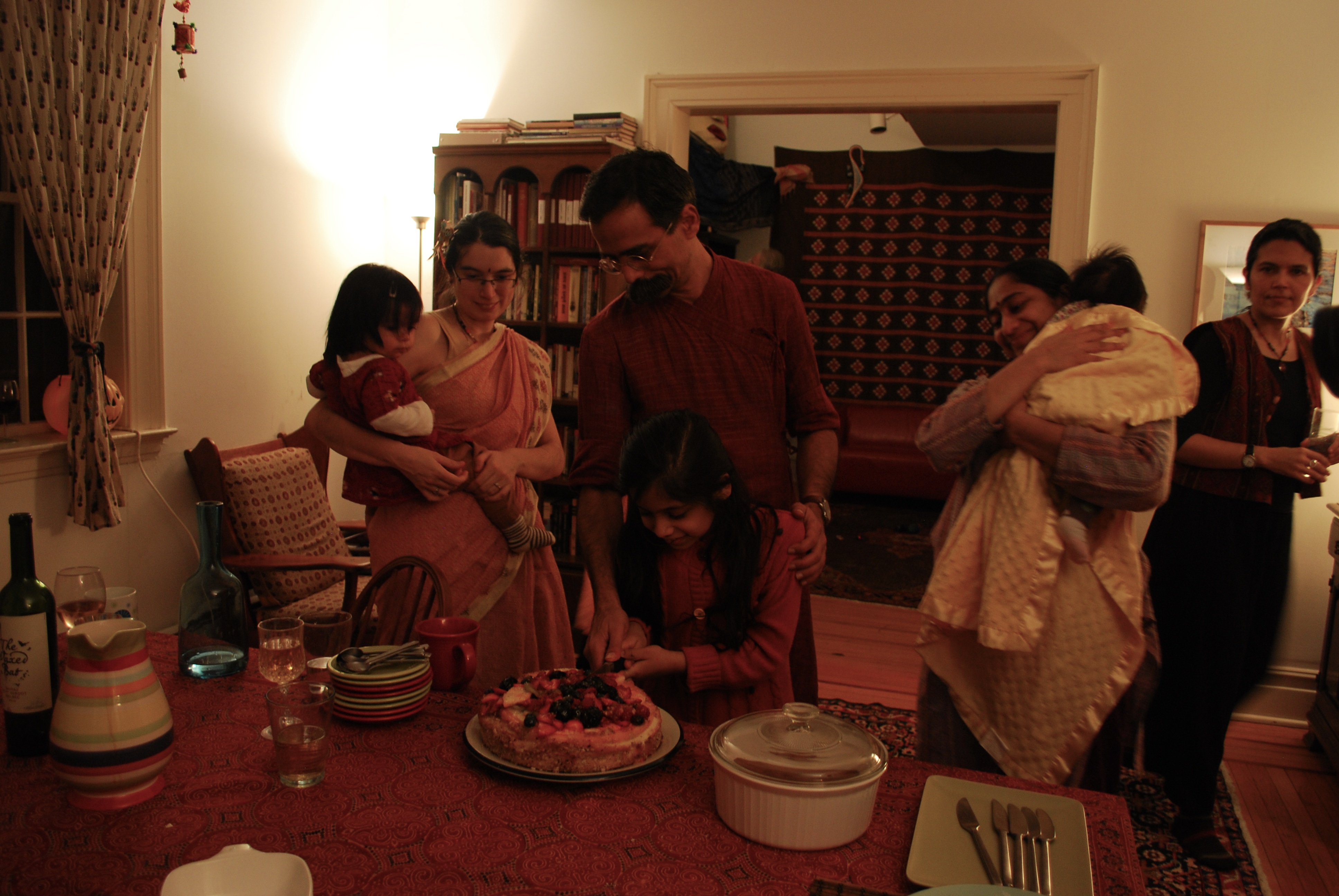
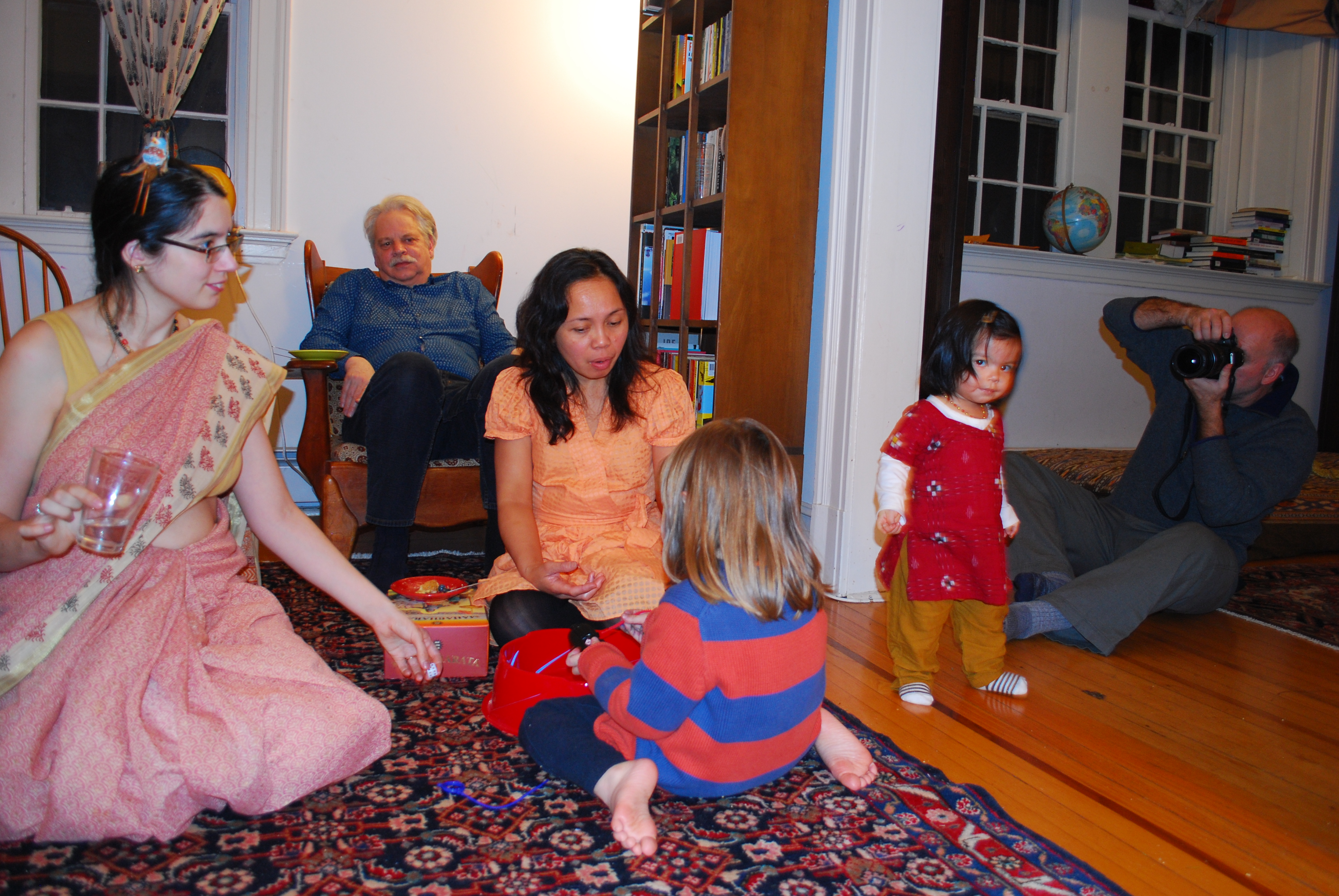
This is part two of a posting that was inspired by two birthdays –mine and Ashish Chadha’s. Ashish is an experimental filmmaker known as Ashish Avikunthak. Certainly Ashish’s 40th birthday deserves some kind of social media recognition–if a website like this counts.  But beyond getting the event on record–what interests me here is the nature of community and friendship. And how we casually slipped into a ritual (in this case a series of potluck dinners) that becomes deeply meaningful and sustaining.  Here are some of the cast of characters.

Ok. This is a tale of three, now maybe four families––but how one makes sense of this group doubtlessly depends on one’s vantage point.  I’ve already made clear that film studies provided the opportunity for my connection with Ashish. And yet, truth be told, our wives were really the first to meet.  The Threese Serana-Ashwini Deo connection came about when Ashwini first came to New Haven (along with her sister) to look for a place to live.  They rented a room on our house for a week.


His wife Ashwini Deo teaches Linguistics at Yale, and so Ashish was a trailing spouse for a few years and taught courses in South Asian cinema.  Our families began to spend time together–mostly potluck dinners, and then Ashish and I suddenly found ourselves co-teaching Documentary Film Workshop in 2009-10 and becoming fast friends. Two other families are also involved in this

Documentary & the Environment: Flo Stone and Chaim Litewski Visit Yale

Posted by chamus on February 16, 2012
Posted in: Uncategorized. Leave a Comment

This entry is under construction.

This is the first time that I have taught the course Documentary and the Environment, which has fifteen students.  The past few days (Feb 13-15) we have had two extraordinary visitors.

Flo Stone, founder and director of the Environmental Film Festival in the Nation’s Capital, came up from Washington, D.C..  We started off with a dinner at Thai Taste with Chandra Simon, who ran the Environmental Film Festival at Yale in 2011


and Richard Miron, who is heading up the programming side of the Environmental Film Festival at Yale this year.

Chandra is now in Documentary Film Workshop while Richard is taking Documentary and the Environment.

After dinner, Flo introduced Earth Days (2009) directed by Robert Stone –no relation.


Happy Birthday to Us-Part I: Documentary Film Workshop as Community

Posted by chamus on February 16, 2012
Posted in: Uncategorized. 1 comment

Ashish Chadha aka Ashish Avikunthak

This posting was inspired by two birthdays –mine and Ashish Chadha’s. Ashish, who just turned 40, is an experimental filmmaker known as Ashish Avikunthak. His wife Ashwini Deo teaches Linguistics at Yale, and so Ashish was a trailing spouse for a few years and taught courses at Yale on South Asian cinema.  Our families began to spend time together–mostly potluck dinners, and then Ashish and I suddenly found ourselves co-teaching Documentary Film Workshop in 2009-10 and becoming fast friends.  The experience helped him get a full-time job teaching filmmaking and film studies at University of Rhode Island (Ashish also has a Ph.D. in Anthropology from Stanford), while it prepared me for my return to teaching filmmaking after a hiatus of roughly ten years.

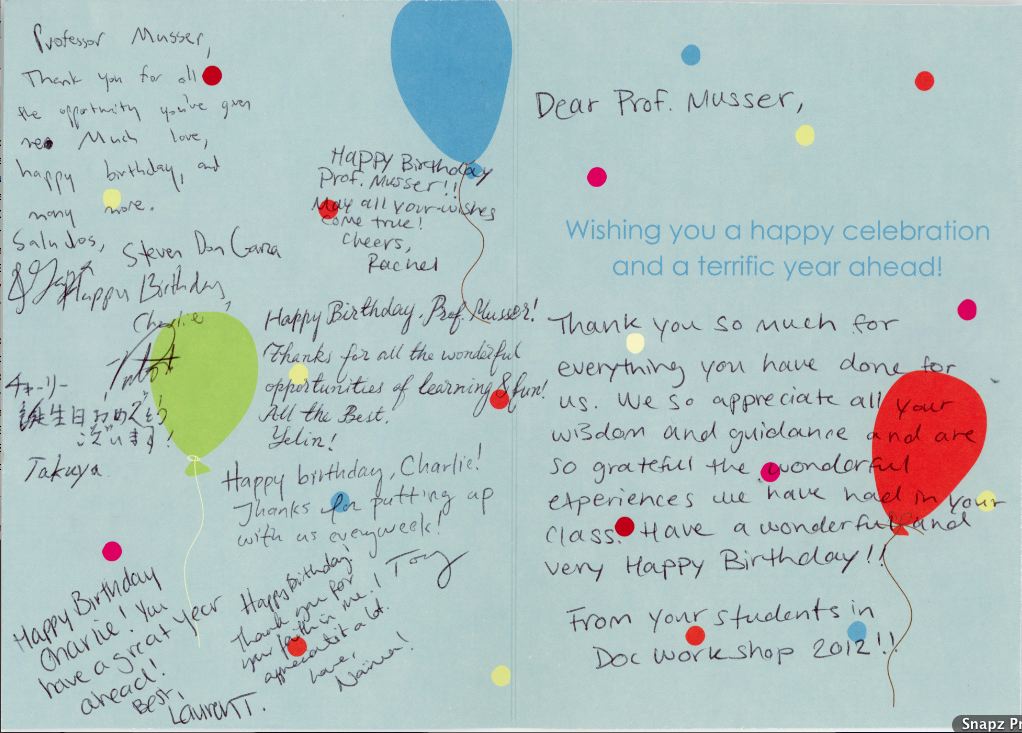
When my birthday popped up this year, students in the current iteration of Documentary Film Workshop gave me a birthday card–and I have to say it was not just my favorite card, it was my favorite present. So I wanted to share it with you.

By now I am all too ready to gloss over my birthdays. I  have many more in my past than there will be in the future. But this card got me thinking about the ways in which the classroom––particularly this classroom––can (and has) become a community and a source of sustenance for all of us.  The fact that Documentary Film Workshop is a year-long course obviously helps.  So too that each student comes into the class with a fairly well defined project–often well under way. But the kind(s) of students who find their way into the course is also important.

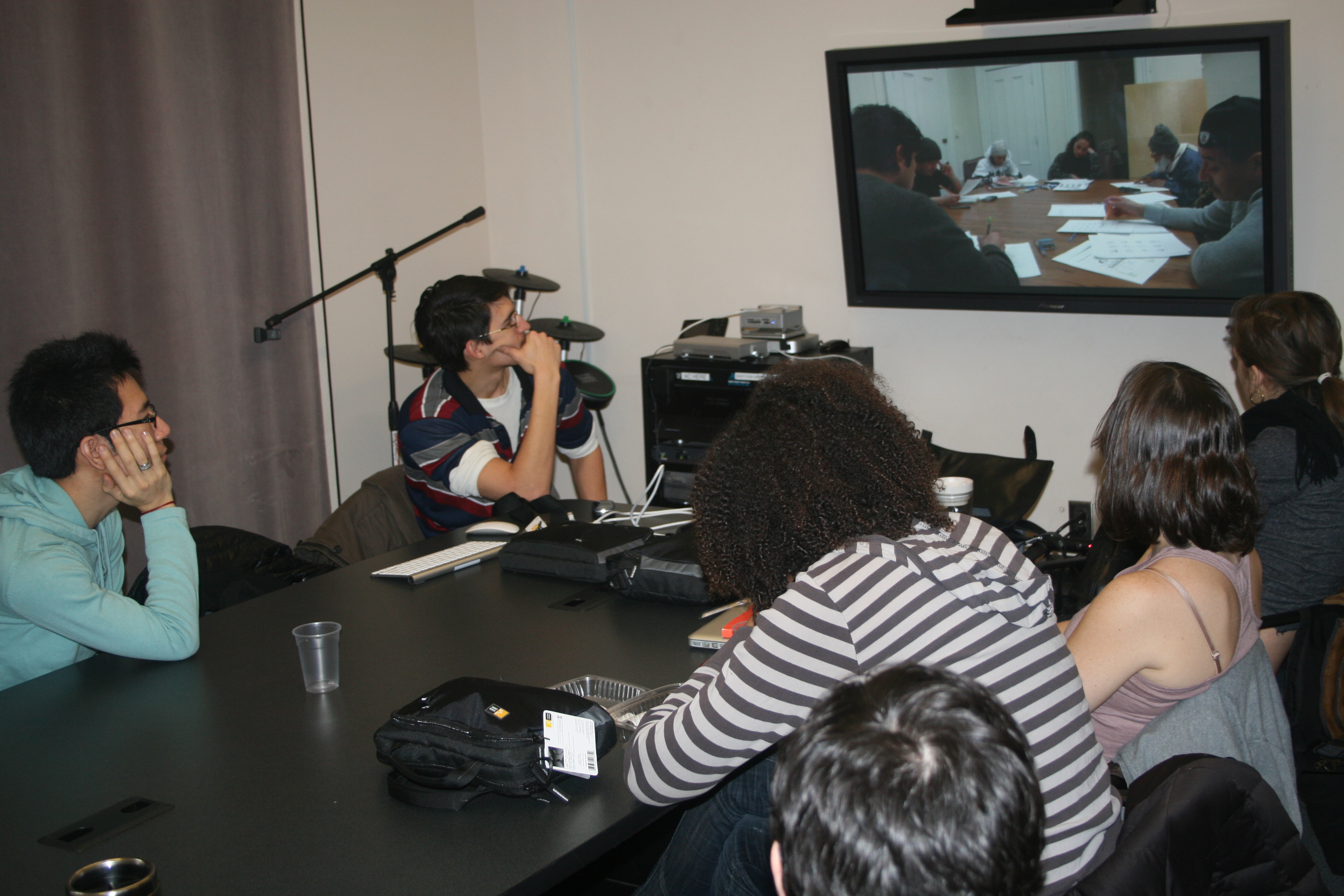
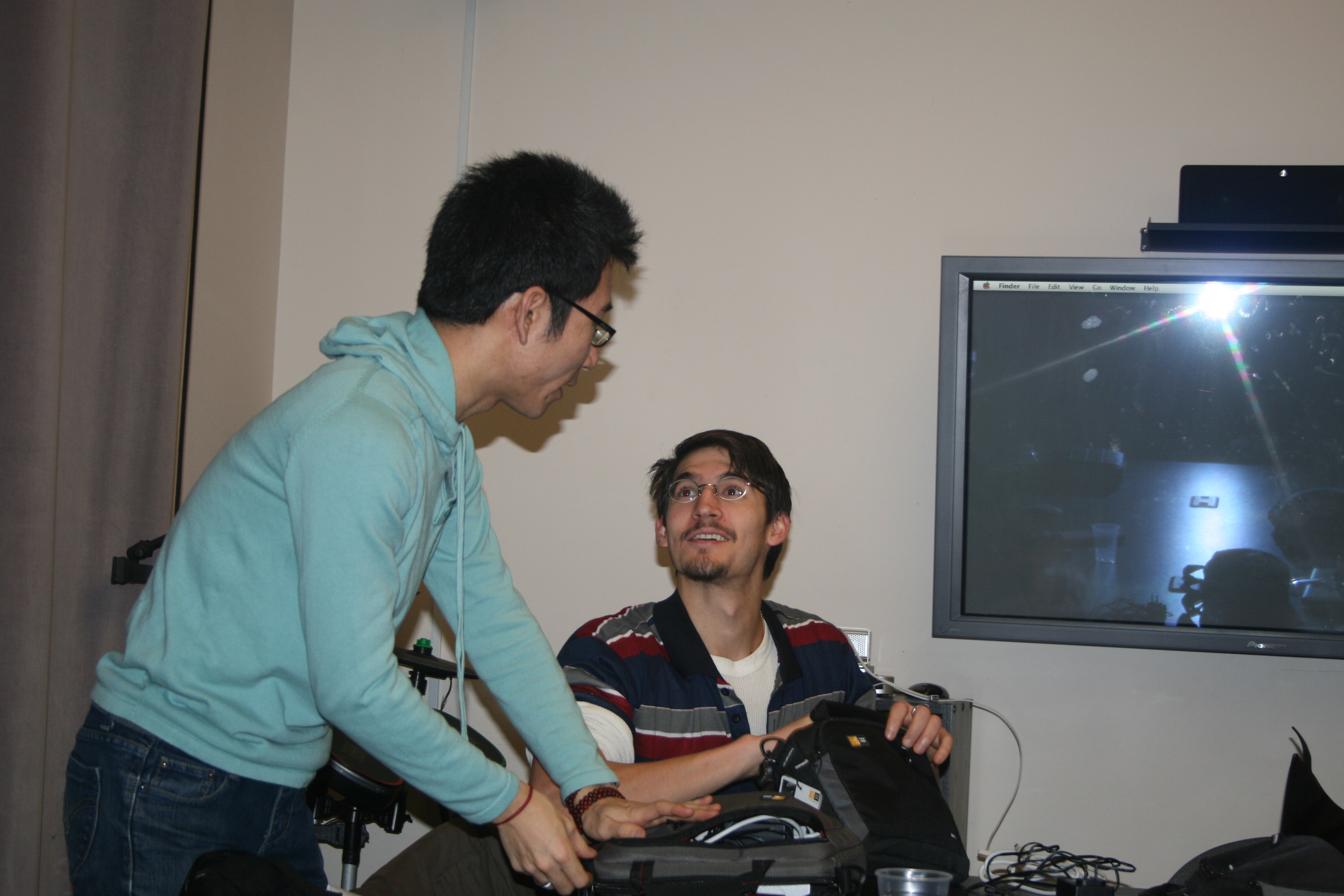
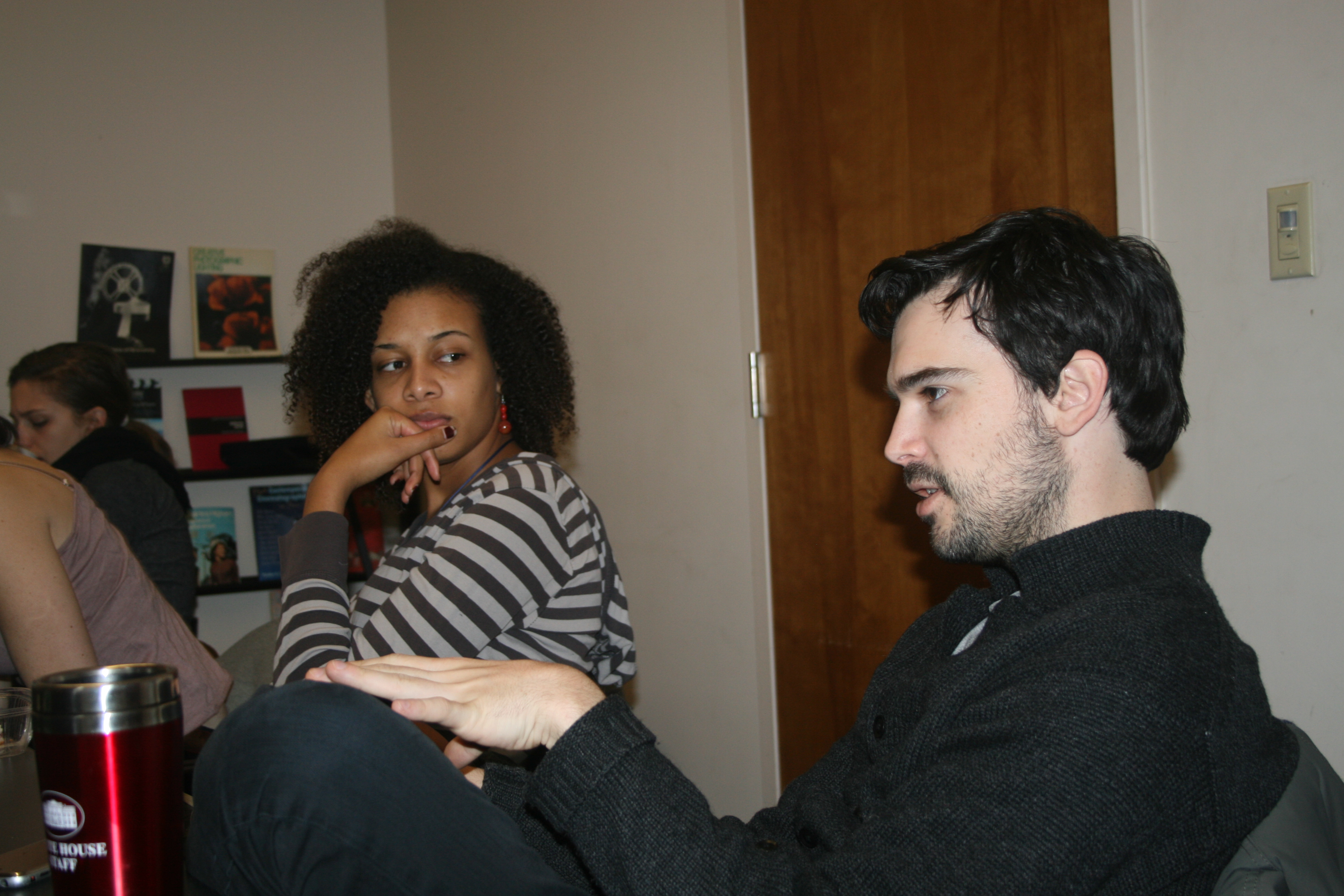
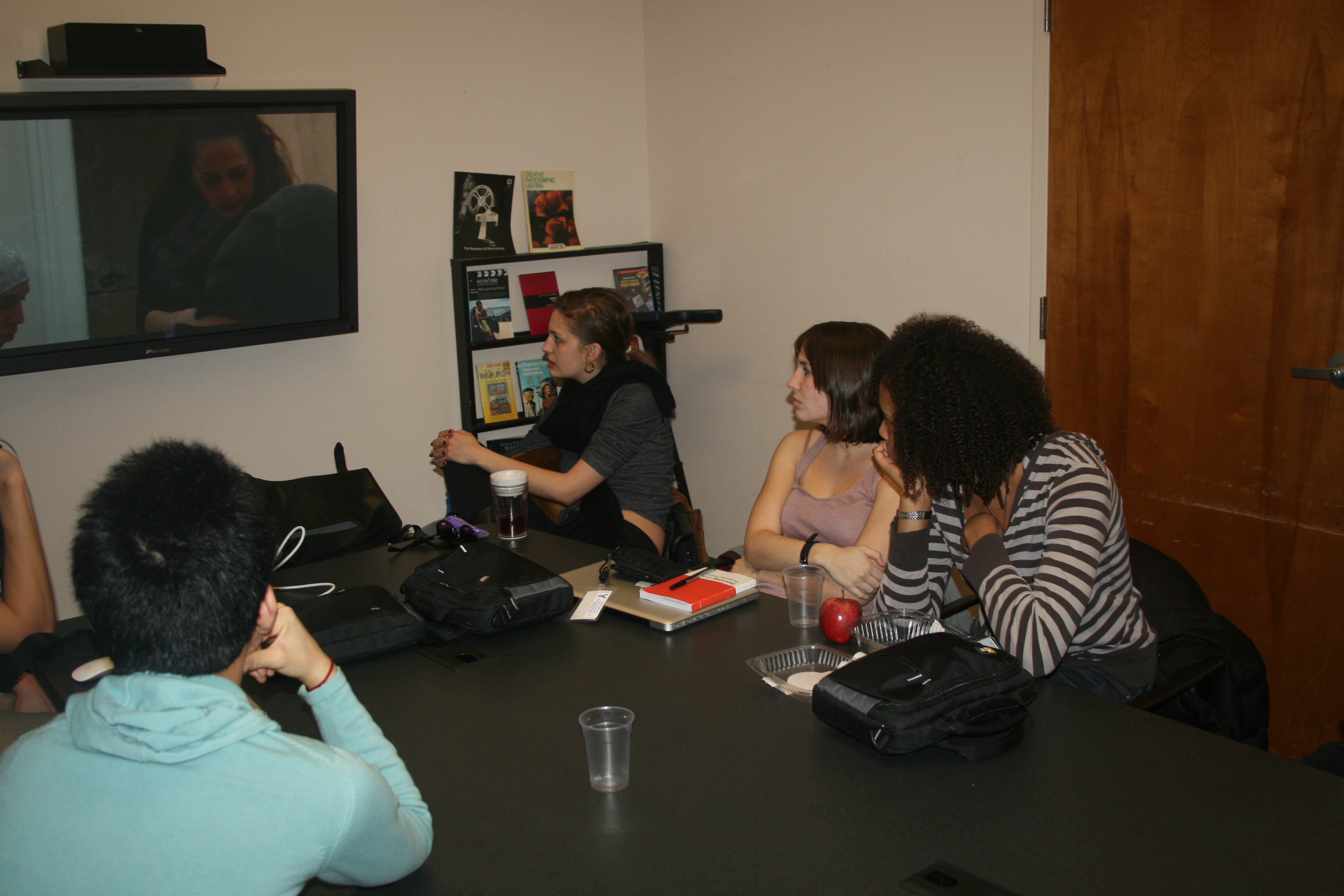
Teaching Documentary Film Workshop is a wonderful privilege.  Our class has roughly twelve members––half are graduate students and half are undergrads (all seniors with one exception). Class meets on Tuesday evenings (for screenings) and Wednesday afternoons at Yale’s Digital Media Center for the Arts:

A few of the students were off filming on the day I snapped these photos, but here we are watching some scenes from Steve Garza’s work in progress, which looks at the lives of a group of New Haven residents who are taking ESL (English-as-a-Second-Language) classes at Yale’s Casa Cultural Latino.

Yelin Qiu and Steve Garza

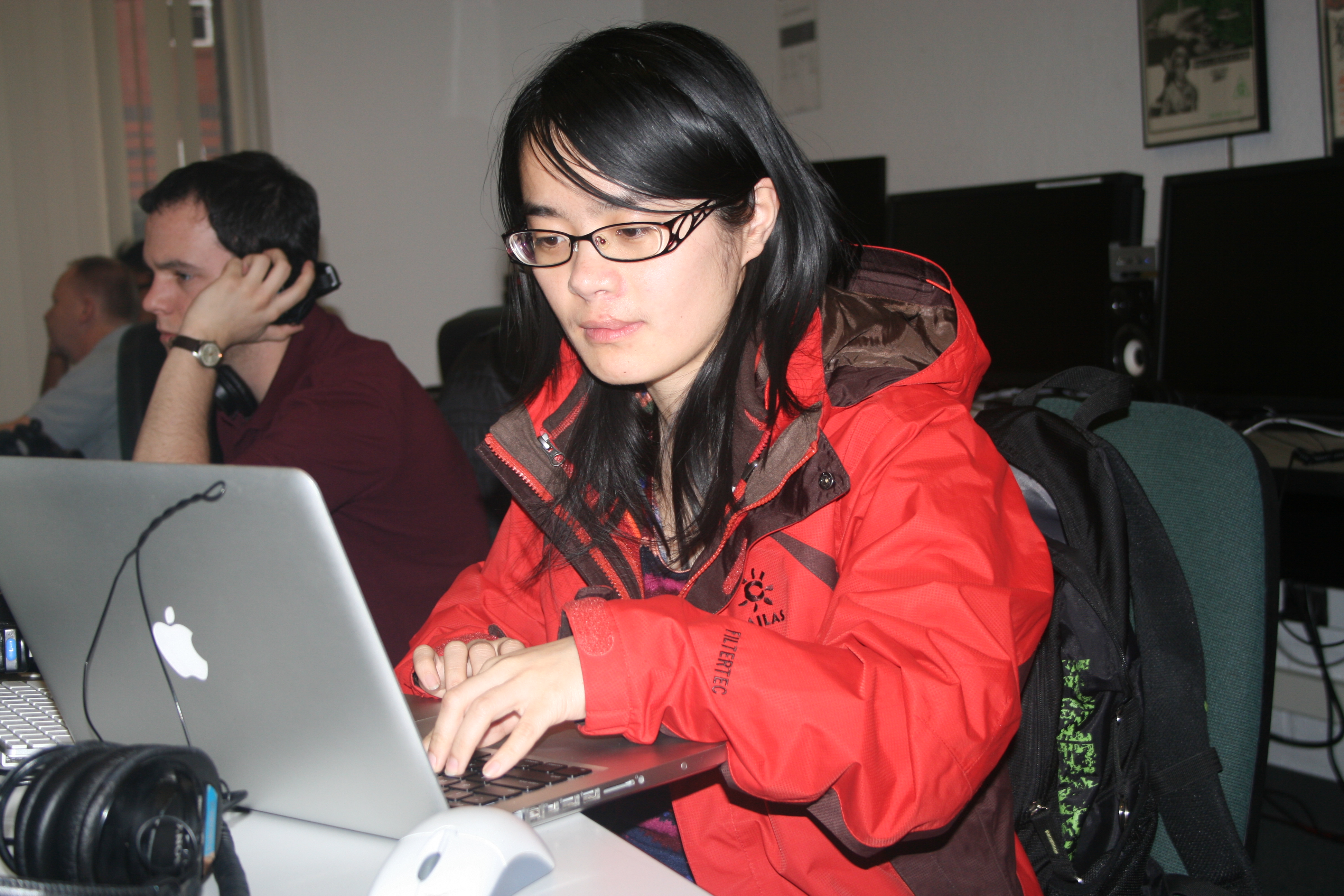
Yelin Qiu is making a feature-length essayist documentary on the rural-urban tension in contemporary China, tentatively entitled The Way Home. He shot most of his footage in China over the summer. By a piece of good fortune we held our preliminary meeting for his project in May, when we were both in Paris.  I was on my way to a conference in Lausanne while he was spending his junior year studying at L’Université Paris Diderot et CPEC (Centre Parisien d’Etudes Critiques).  While talking about his project, I walked him over to rue Daguèrre and we knocked on Agnes Varda’s door.  By chance he’d met her the night before at a screening of Les glaneurs et la glaneuse–and I wondered if he might find a small place for her in his film. She wasn’t home, and a few days later he left for Bejing.  On this particular day, Yelin showed us a wonderful scene of a family making charcoal in rural China..

Naima Sakande and Patrick Reagan

Naima Sakande, a Sophomore, videotaped more than a dozen interviews with residents of a Cambodian village this past summer as part of the Khmer Legacies Project organized by Socheata Poeuv, director of the documentary New Year Baby (2006).  While the interviews focused on the genocide under Pol Pot, Naima’s subjects also offered up a larger history of the village.  She has been getting the material translated and is planning to offer us a historical portrait of the village.

Patrick Reagan is a Film Studies/German Ph.D. student making a documentary about community gardening in several different parts of the United States.  He has a collaborator, Drew Paonessa, who lives in Los Angeles. The filmmakers often shoot independently on opposite coasts but have met mid-continent a couple of times: in Detroit, where they interviewed Grace Lee Boggs, and in Chicago, where they interviewed Bill Ayers.  In a loose way, Patrick’s documentary is related to his dissertation project on utopia and distopia in contemporary European cinema.

Danielle Tomson and Tory Jeffay

Danielle Tomson is working on a documentary about radical Islam in Kosovo, where she had been filming over the past summer.  As with Naima, one of her biggest logistical challenges involves translation. Tory Jeffay is making a documentary about scrapbooking–a little-examined subculture of women. She showed some highlights to a group of Mellon fellows soon after our class meeting: it is going to be a very engaging film.

TSUNODA Takuya

Takuya Tsunoda is a Ph.D. student in the combined East Asian Language & Literatures/Film Studies program.  He is writing a dissertation on Iwanami Productions and was hoping to make a documentary about one of its directors (HANI Susumu) but was disuaded when it appeared that he would not get back to Japan until the summer of 2012.  Instead he is working on a documentary about MORI Tatsuya, the controversial documentarian who recently finished a feature-length video entitled 311–on the earthquake and tsunami that hit Japan on March 11, 2011.  Mori was expected to come to Yale to show his film but had to cancel at the last moment.  He provided a Q & A via Skype after the screening, which Takuya filmed instead.  Takuya’s documentary is becoming one of those classics in which the filmmaker is chasing after his always elusive subject.


The class met again and several of the absent ones were back.  So I broke out my camera again.

Rachel LaViola

For her senior project, American Studies major Rachel LaViola is making a documentary about the inadequate support system that Texas provides children with autism–-specifically in the public schools.  As is often the case with such projects, there is a strong autobiographical component: her brother Zach has autism.  As with other families in this situation, it has had a profound impact on every aspect of their daily lives.  Rachel shot hours of footage over the past summer and has repeatedly return to Texas to film during the school year.  Her confidence and abilities as a cinematographer have become steadily more impressive.  Rachel’s initial idea was to present a number of case studies, with her family being one of them.  When she showed us footage, her brother Zach proved to be a very sympathetic figure despite his many challenges.  When Rachel played a recording of Zach singing “Somewhere Over the Rainbow,” we were in tears and knew that she had found her subject.

When looking for ways to be helpful, I talked to NYU’s Faye Ginsburg, a friend and former colleague who has become an expert on documentaries dealing with disabilities as a result of her own daughter’s illness. Faye told me there is a whole subgenre of documentaries on autism which have been made by family members.  I got the Film Study Center to purchase some of them so Rachel could become familiar with the genre in which she was operating.  Indeed, each week in the fall semester our class looks at a documentary related to one student’s work, and upon Rachel’s request we screened Beautiful Son (2007), which Hawaiian filmmakers Don and Julianne King had made about their autistic son.  This moving film made clear that the documentary focusing on a cute young boy with autism had already been done and it pushed Rachel to move beyond that idea (and pushed her fellow classmates to offer suggestions from a new and broader perspective).  Rachel’s mother Mara LaViola, could not have agreed more.  As a Special Education Child Advocate, she frequently represents families with autistic children as they seek resources from local and state governments.  She was frustrated/disappointed/angered by our earlier advice to Rachel (ie to focus on her sympathetic brother to the exclusion of those who were less photogenic and yet often face even more severe problems).  Another student in the class has a brother with autism.  So we are all learning more about this increasingly common condition through Rachel’s project.

Lauren Tilton and Chandra Simon

Lauren Tilton is a Ph.D. student in American Studies and her documentary fulfills requirements for the MA in Public Humanities, now being offered by Yale’s American Studies Program. Her documentary comes out of an innovative engagement with the Farm Security Administration and Office of War Information photographs that are archived at the Library of Congress.  Working with several colleagues, she has come up with a web-based program that will enabled users to see the sequence of images as they were taken by individual photographers.  Through funding from the NEH, Lauren is now implementing this transformation of the ways in which the archive can be used.  Her documentary is an independent but relatd project about the FSA/OWI archive and some of the insights into the collection that her new approach allows.

Chandra Simon, a MA student in the school of Forestry and Environmental Studies, joined the class this spring.  She is a veteran producer who was director of the Environmental Film Festival at Yale for 2011.  As she explained in an email, her documentary project is “constantly evolving and changing in scope and format but basically I’m profiling farmers and activists who are trying to create a more sustainable and healthy food system.”

Anna Loar and Lee Faulkner

No effort to explain the essentials of Documentary Film Workshop would be complete without acknowledging the critical role played by the DMCA (Digital Media Center for the Arts), its Associate Director Lee Faulkner and Technical Specialist Anna Loar. Without them, nothing would be possible.  In a world where everyone has to be evaluated and ranked from 1 (poor) to 10 (outstanding), they both rate a 12, which is reserved for real-life super heroes.  Why? The energy at the DMCA is very special.  Lee is my unofficial co-teacher, training students on cameras, Final Cut Pro and microphones.  Anna, who runs her share of workshops and provides crucial support to all of us, is a singer and musician in her other life.  She’s a major recording artist just waiting to be discovered.

  There is that always important moment when the subjects (“my students”) refuse to be passive objects of my authoritarian gaze.  (In different ways it happens all the time!) When I put down the camera in order to make a point, Yelin took control and began shooting.  His snapshots made me realize that mine had tended to be portraits of students watching or listening.  Certainly this is not the representative of our classroom dynamic but rather reflects my limits as a photographer. Yelin took some other shots: here is one of Naima–just to offer some visual evidence.

I’m trying to reform.  Here’s a shot I took of Takuya in action.

And when Lauren Tilton’s cameraman did not show up for a shoot, I became her gofer.  She was filming Alan Trachtenberg, author of Reading American Photographs: Images as History, Mathew Brady to Walker Evans. I  brought along my trusty Canon and snapped a few after the interview was over.

Lauren Tilton filming Alan Trachtenberg

We have a few other classmates, I should mention as well.

Tiffany Ruosi Wang is getting a Master’s in the School of Public Health, coming to Yale via Peking University.  She came to the workshop with almost no filmmaking experience but a fierce determination to start making documentaries.  She also came with an interesting idea for a project: the decision––often a real dilemma–– that Chinese students face as they approach graduation––to remain in the US or return to China. She is not in the classroom very often this semester since she has a required course that meets at the same time as our workshop.  So we tend to meet tutorial fashion–or at Tuesday evening screenings.

Janett Buell is a third year Ph.D. student in German and Film Studies.  Last year she took my critical studies course Digital Documentary and the Internet and was won over to documentary as a field of interest.  Thus her wish to make one (understanding this mode of filmmaking from the inside).  Janett has been a theory head and so her novel but quite brilliant choice of a subject: the color “grey” –or is it “gray”? And is it a color?  I can’t reveal any more, but this is only the beginning of her multi-faceted approach to this subject.  Headed into the spring semester, Janett found herself preoccupied with orals (plus teaching), and so she has taken a one semester sabbatical from the class, returning in the fall.  I took this photo in a coffee shop while we met to discuss her orals: the papers in front of Janet are some of the relevant lists of books and films she needs to read and view.


Back in Japan: A Conference on Acting––with Jet Lag.

Posted by chamus on January 29, 2012
Posted in: Uncategorized. 1 comment

I went to Japan for the first time in March 1985 to show Before the Nickelodeon: The Early Cinema of Edwin S. Porter.  My sponsor was Kenzo Horikoshi, who will always be a personal hero of mine.  He had (and has) a small theater, called EuroSpace, and was also a distributor and art film producer.  He screened my documentary at EuroSpace where it was immediately preceded by Basket Case, which Kenzo also loved.  (From my perspective, the one thing these two films had in common–other than Kenzo’s enthusiasm––was that we had shared some of the same cheap film services in the Film Center Building, 9th Avenue and 45th Street in New York City.)  Kenzo’s distribution strategy involved taking me all over Japan to show the film in small ciné clubs: while in Sapporo we did some spring skiing; while in Kyoto, we went to a night-time spring festival and drank beer under the cherry blossoms.  Kenzo apologized for not getting tickets to the opening day of the Yomiuri Giants.  We were going on the second day of the season––except opening day was rained out so the second day of the season became the opening day.  It was that kind of trip.  People loved the film (one local critic put it on his list for 10 best films of the year).

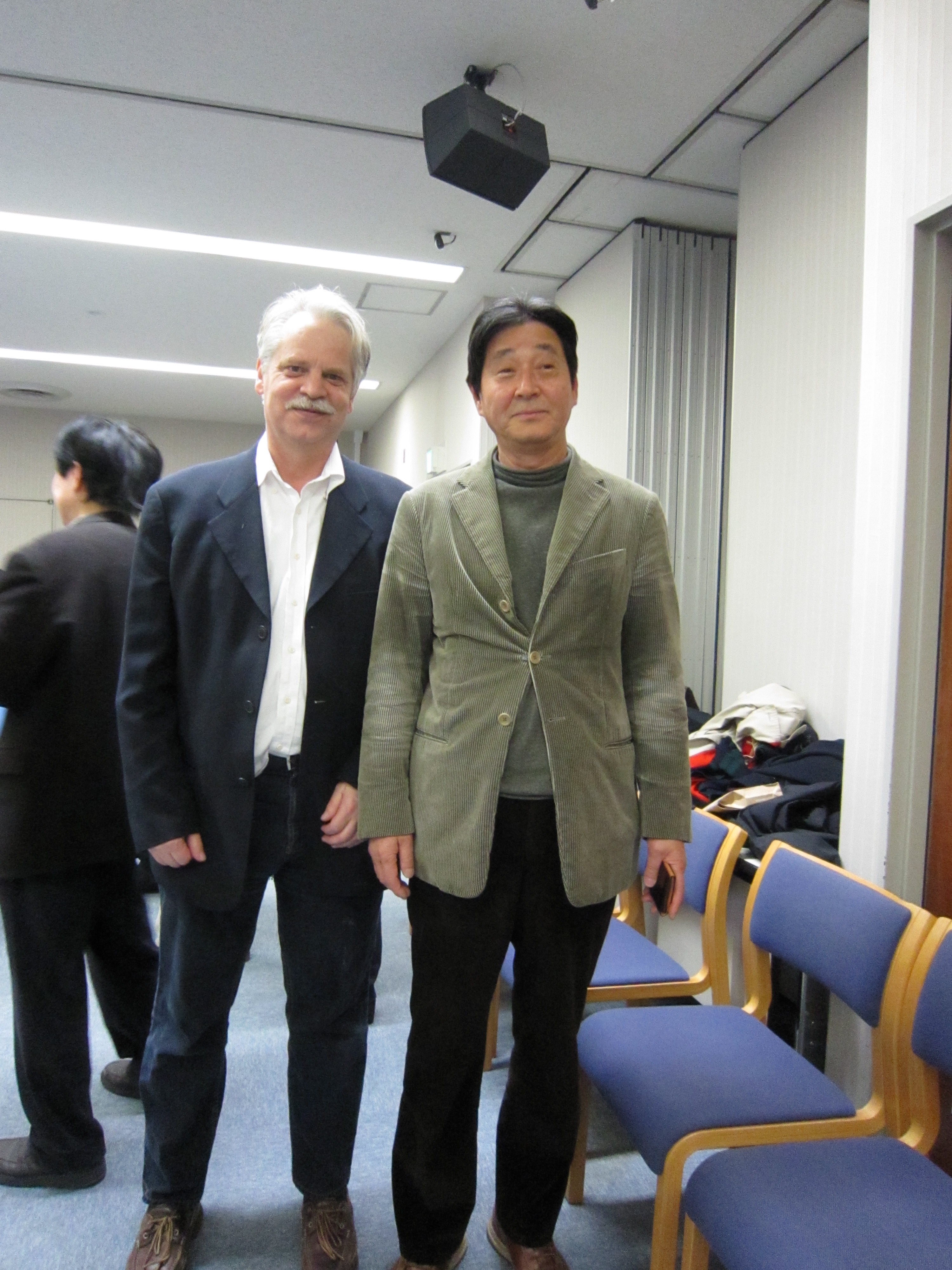
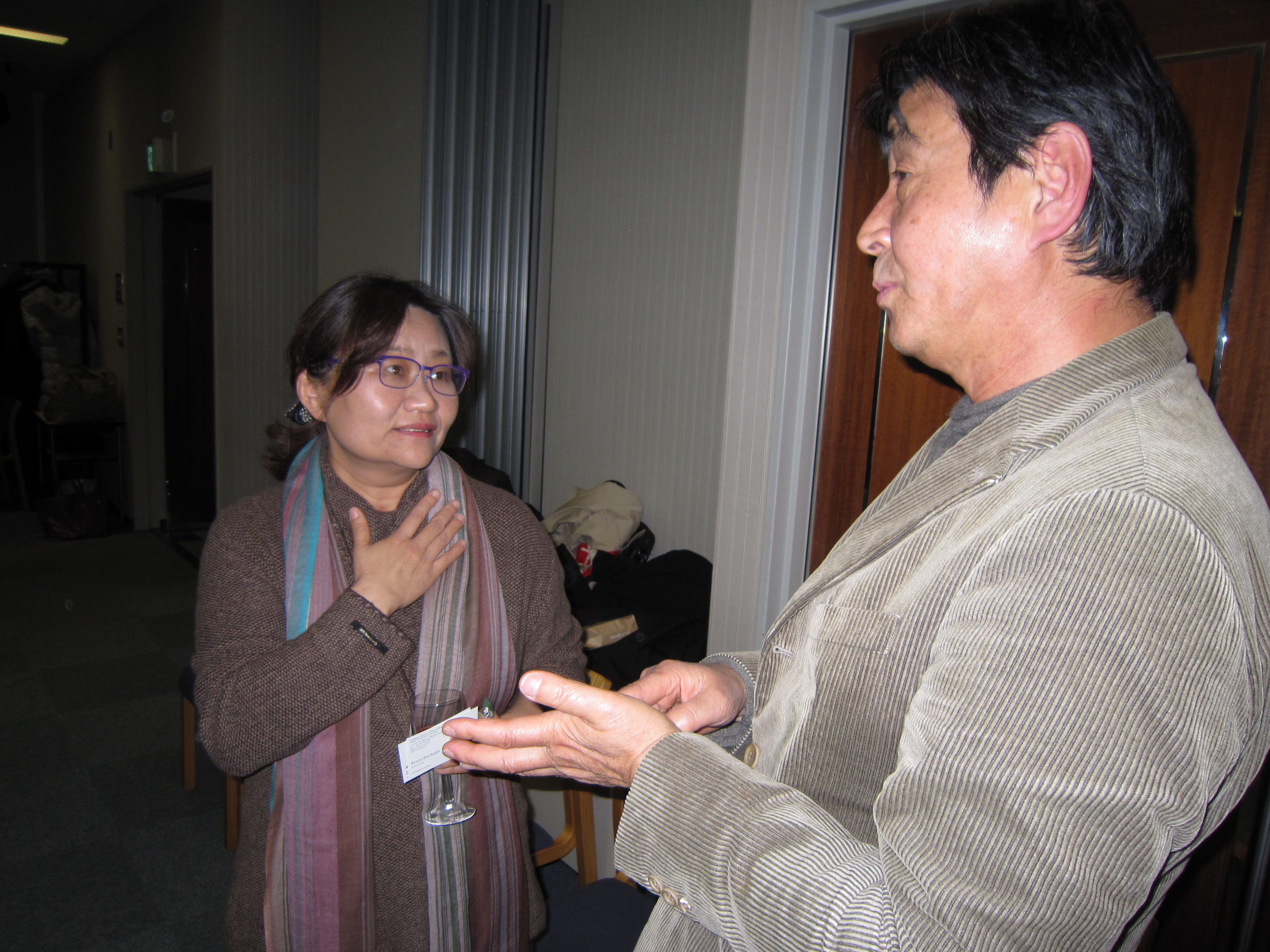
Reunited with Kenzo Horikoshi


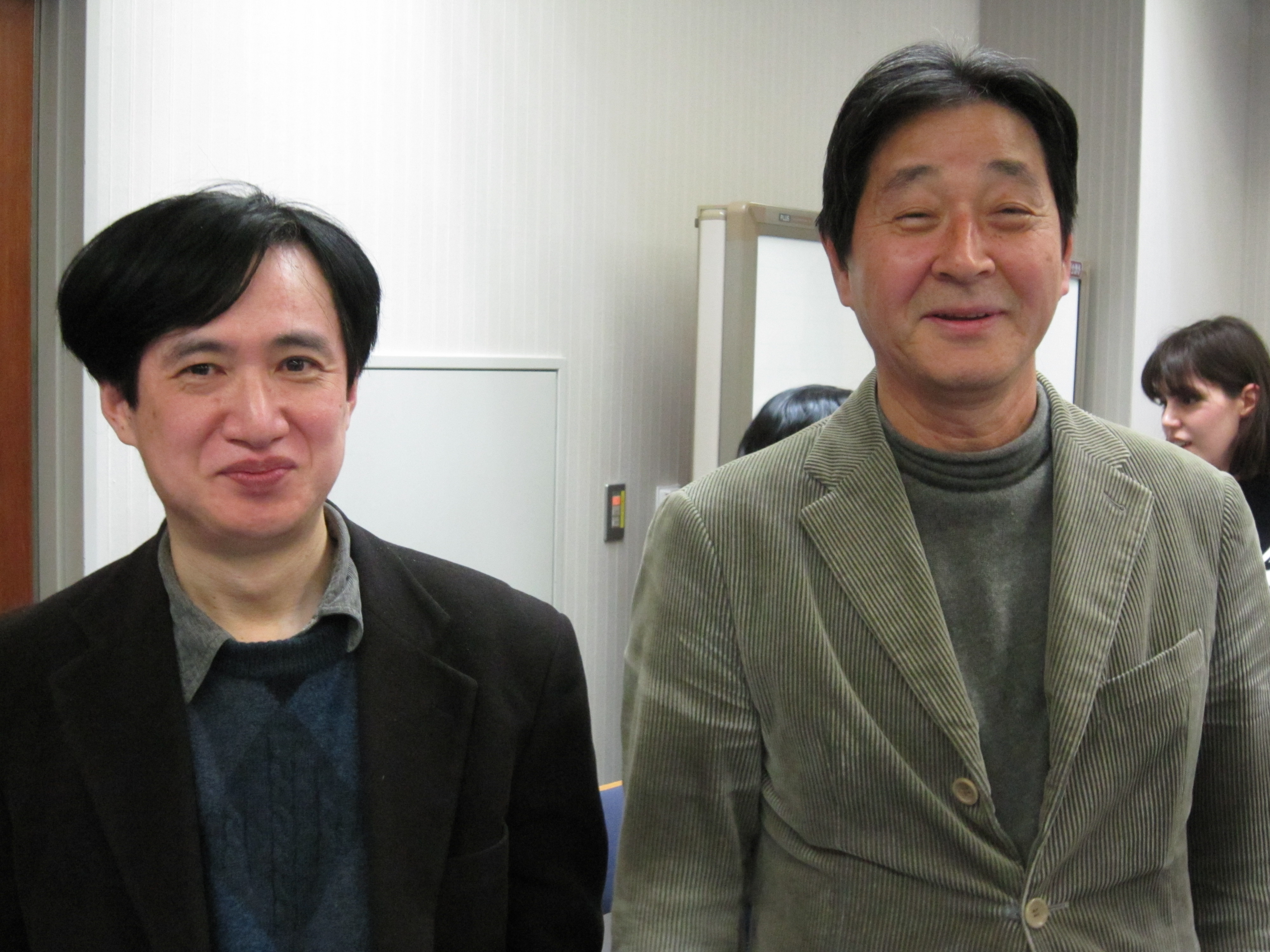
As part of promoting the documentary, Kenzo had me give a presentation to a large Tokyo audience while I was in the midst of serious jet lag.  He also had a small entourage of young cinephiles around him, one of whom was a graduate student (like me) interested in early cinema: Hiroshi Komatsu.  Hiroshi and I went on to collaborate on an essay entitled “Benshi Search” –about “the last benshi,” Matsuda Shunsui, and his student, Sawato Midori.  Now Hiroshi is Komatsu Sensei, head of the cinema section at Waseda University and it is he who invited me to the conference.  And so, some 27 years later I am back for my second Tokyo presentation (though I have been to Japan a few times in the interim, notably in Kobe for the 1995 conference that celebrated the 100th anniversary of cinema).  In 1985, I had brought a bottle of Jack Daniels as a gift for my sponsor Kenzo Horikoshi.  Now, it was  with the greatest pleasure that I brought a bottle of Wild Turkey to give to my current sponsor, Hiroshi Komatsu.

Hiroshi Komatsu and Kenzo Horikoshi

Kenzo has also moved into academia, setting up the Graduate School of Film and New Media in Tokyo University of the Arts–the first and only national program in filmmaking in Japan.   He is the director-professor.  Horikoshi Sensei will also be taking Kiarostami’s latest film (entitled The End), which he has just finished producing, to Cannes. (As for HK and KH, it is worth noting that Komatsu went to Tokyo University of the Arts, while Horikoshi went to Waseda–so it is more than their initials that the two have flipped.)

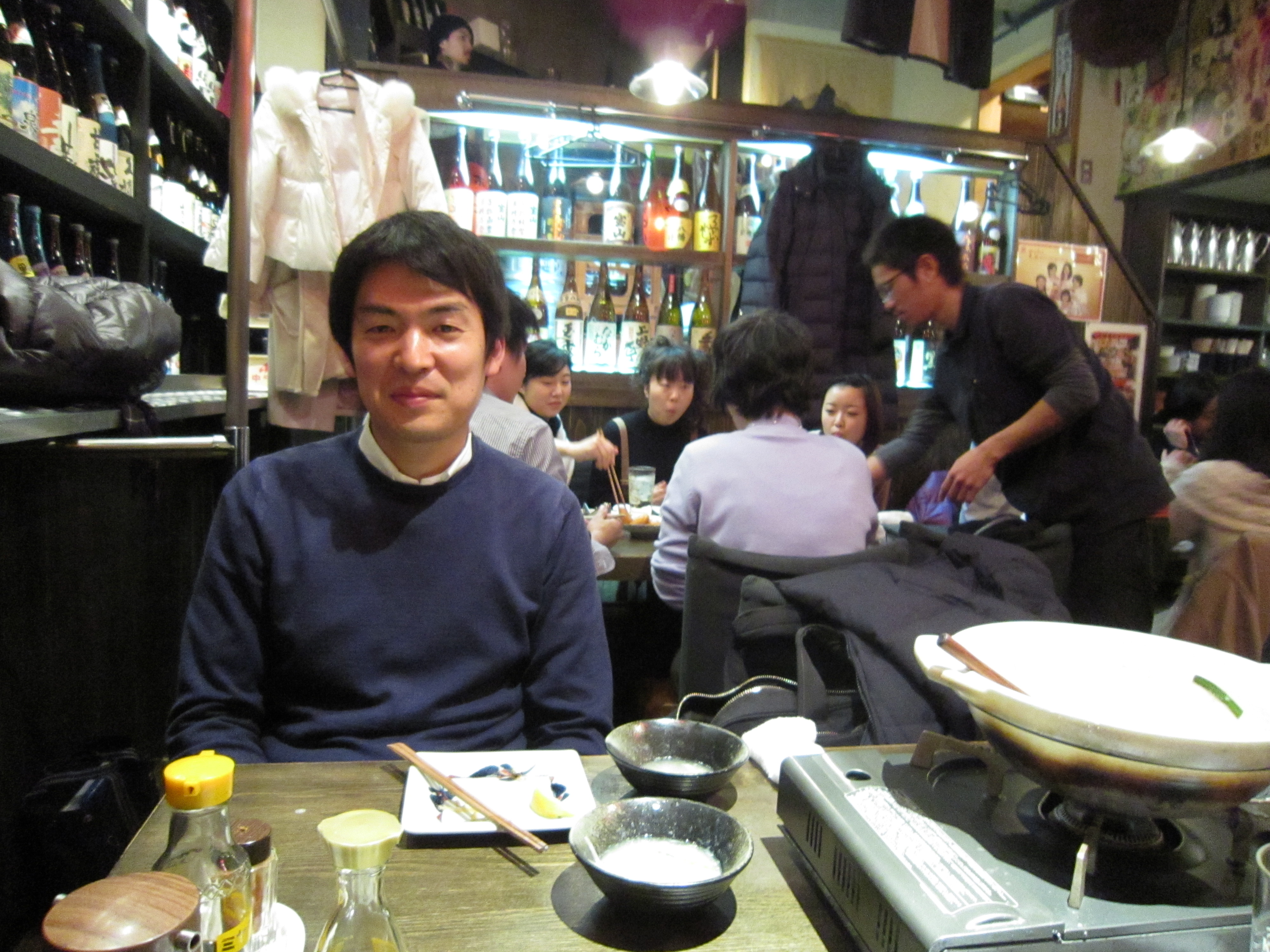
DAIBO Masaki

Although I am considered a regular at Kodama Restaurant on 45th Street and 8th Ave in New York City (I have my own bottle of Sochu behind the bar), Japanese food in Japan is something special.  My handler, Masaki Daibo, took me to a local bar.  A favored hangout for some––and not too expensive:  the food and Sochu were great. And, since it was one of comparatively few bars open on Sunday, I ended up returning the next evening. FYI: Daibo took most of the photos for this blog entry. (Thanks Masaki)

Kim Soyoung & Horikoshi Kenzo

If you, dear reader, expect me to blog a conference in Japan on 10-hour jet lag, you have unrealistic expectations.  The conference was on Acting and there were several other keynote speakers I enjoyed hearing: Erin Brannigan, an Aussie who has published Dancefilm: Choreography and the Moving Image; and Paris-based Christian Biet, who teaches brief stints at NYU, represented Theater Studies, but spoke in French. Kim Soyoung, a Professor of Cinema Studies at Korean National University of Arts, is ABD from NYU’s Department of Cinema Studies, makes films (mostly documentaries) and writes books (in Korean, though she has essays in English and presented her paper at the conference in English). She shared an essay on early cinema in Korea which situates it within a larger media framework that includes public oratory and initial efforts to build a democratic movement. We seem to be thinking along similar lines.

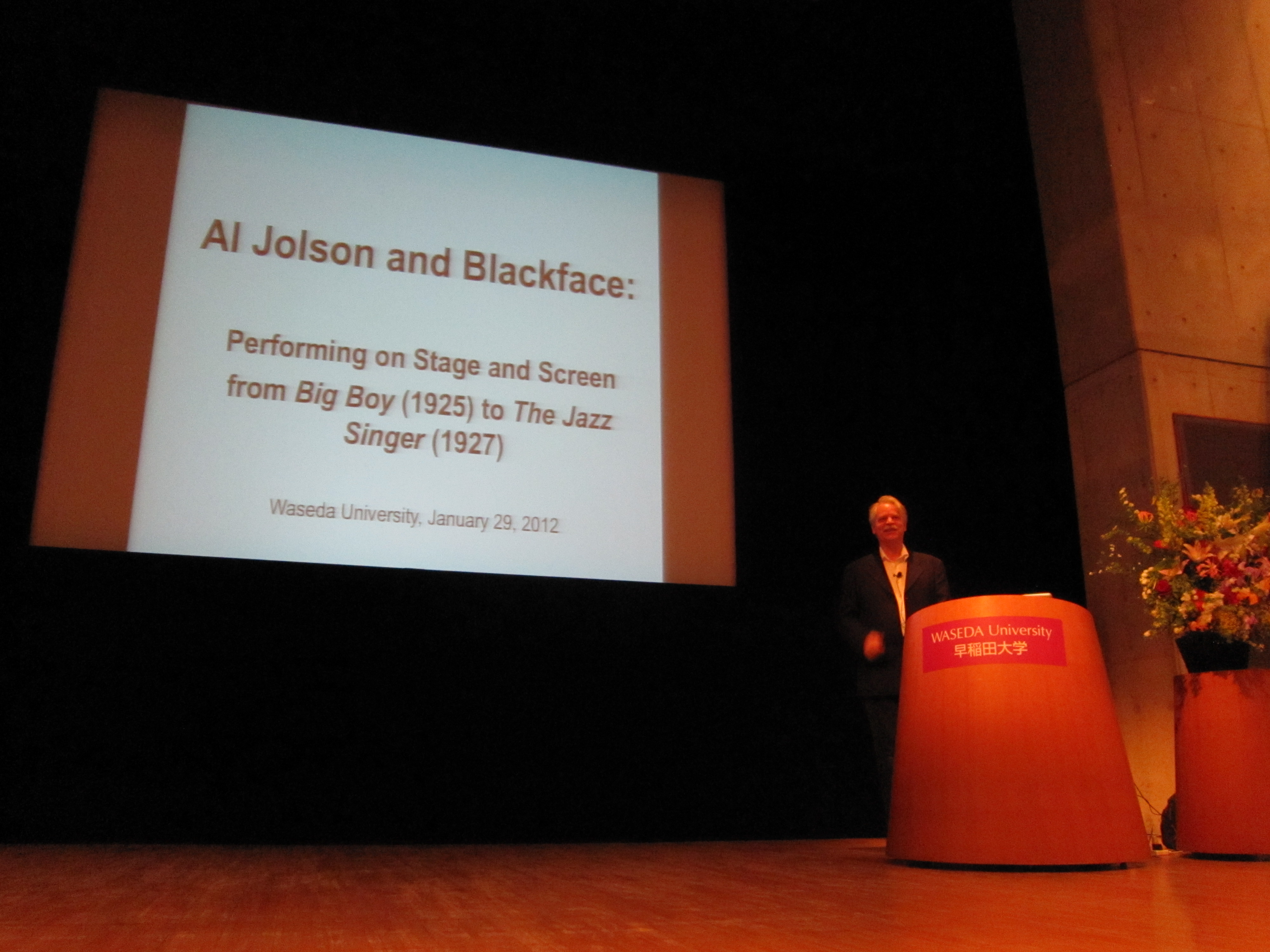
My own talk “Al Jolson as a Performer: Moving from Stage to Screen” was delivered with a slightly different title and built on recent work I have done on The Jazz Singer.  In brief, motion picture acting has often been understood as a more restrained variant of stage acting (even to the point of being non-acting).  However, Jolson shows how this rule of thumb can lead us astray–and facilitate the widespread conviction that his blackface performance demeaned Negroes and was racist.  As a performer on stage, Jolson regularly moved in and out of character–from being Al Jolson in black face to being Gus, the Negro character that he played in his musical reviews.  In Big Boy (1925) he used this performance style to align himself with his fellow black performers and to play with the color line in ways that were transgressive.  When he moved to film, however, Jolson also shifted to a coherent, naturalistic acting style.  This worked well enough for The Jazz Singer, where the oscillation was displaced onto a different level (black face as the mask of theater vs. the Rabinical robes of orthodox Jewish religion that his father wore).  But when he starred in the 1930 film version of Big Boy, his uni-vocal approach undermined his stage achievement.  I threw in a little Marx Brothers: Chico in Animal Crackers, whose Jewish identity is momentarily exposed as Roscoe W. Chandler (formerly known as Abie the Fish Peddler) wonders how he became Italian.

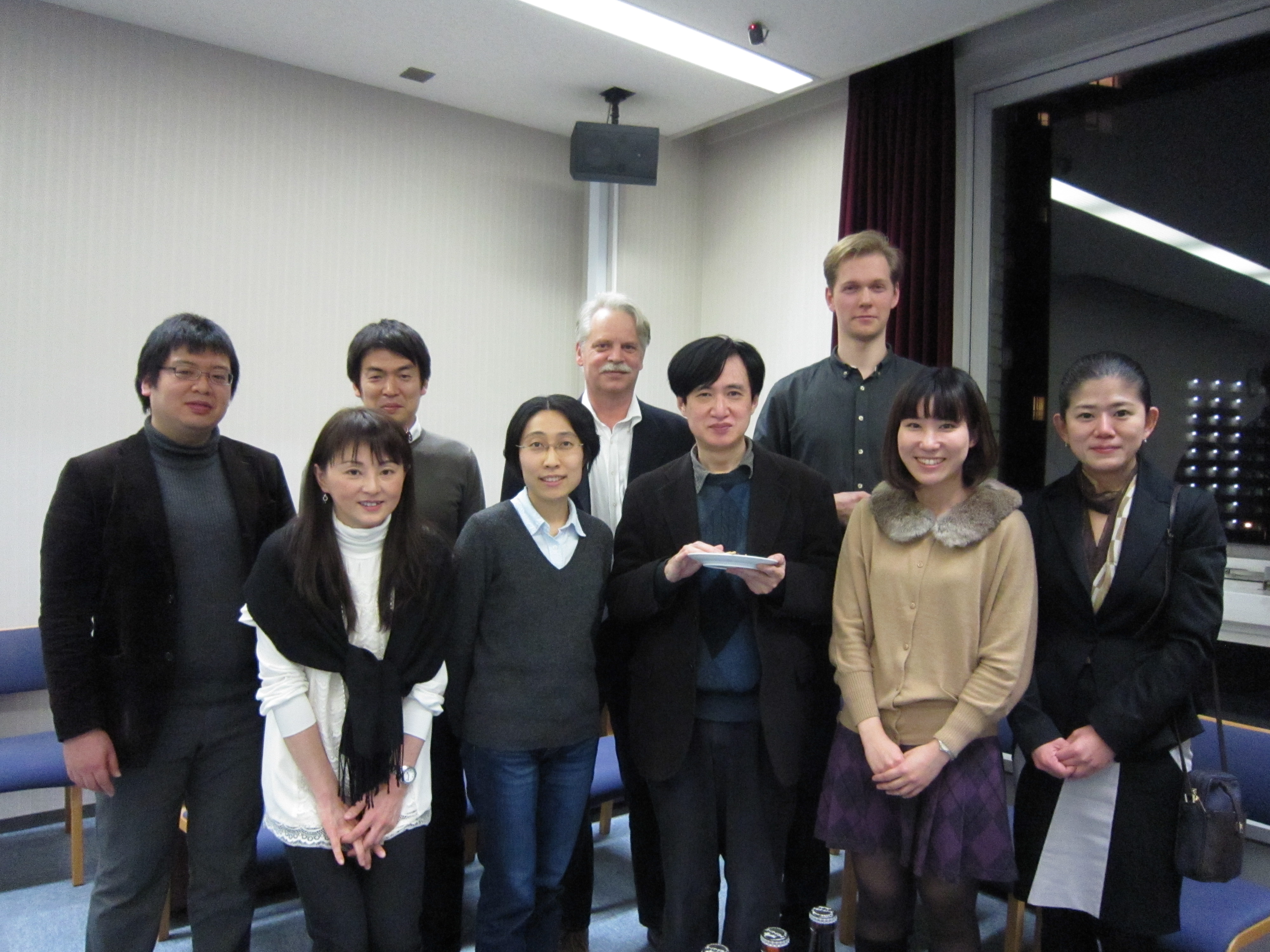
One of the real pleasures of the trip was meeting the group of graduate students clustered around Komatsu.  Three of them are going to Boston to attend SCMS in March.  Now they are going to make a second stop in New Haven to meet some of their Yale counterparts.

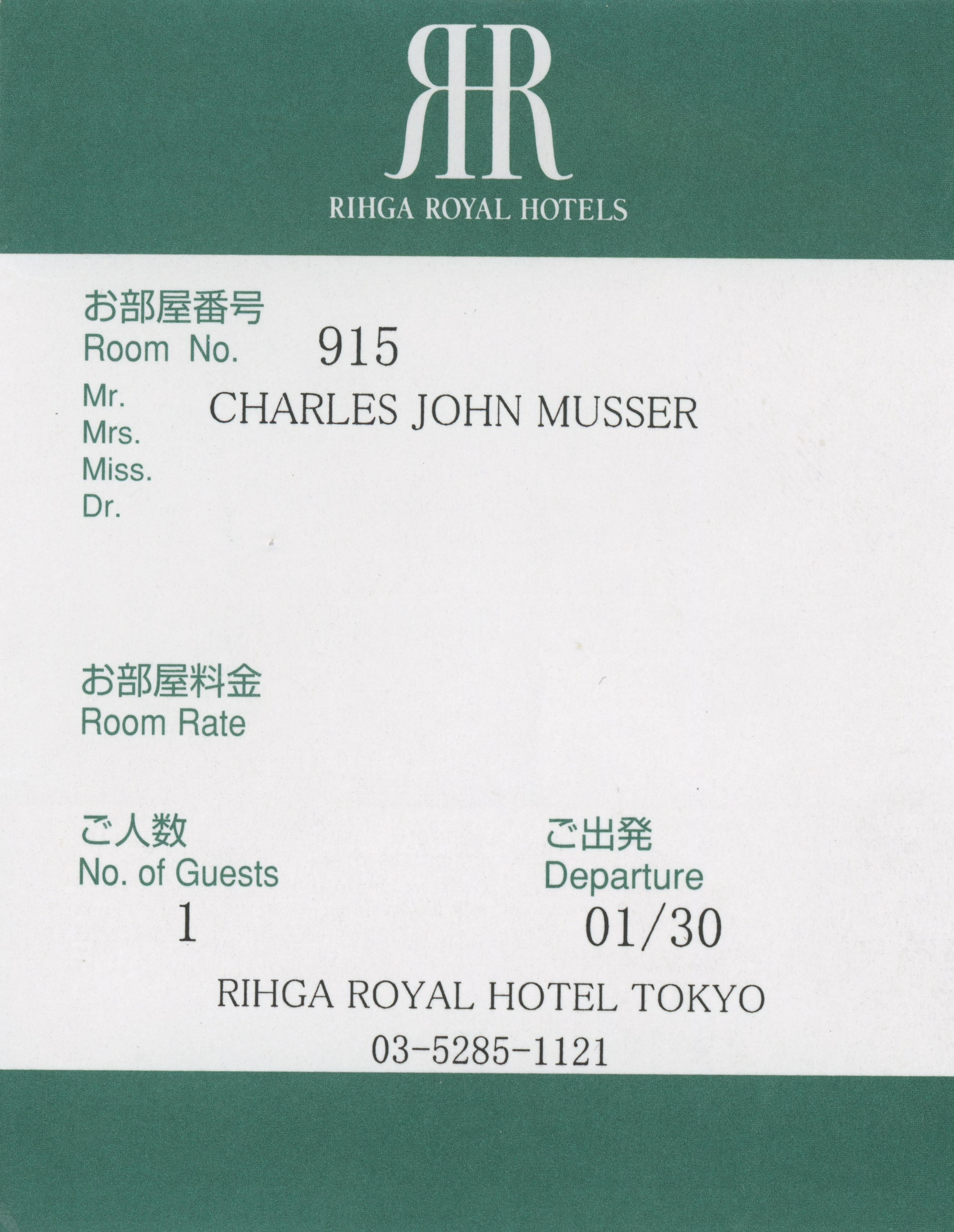
The Hotel that was Designed to Make Jet Lag Bearable


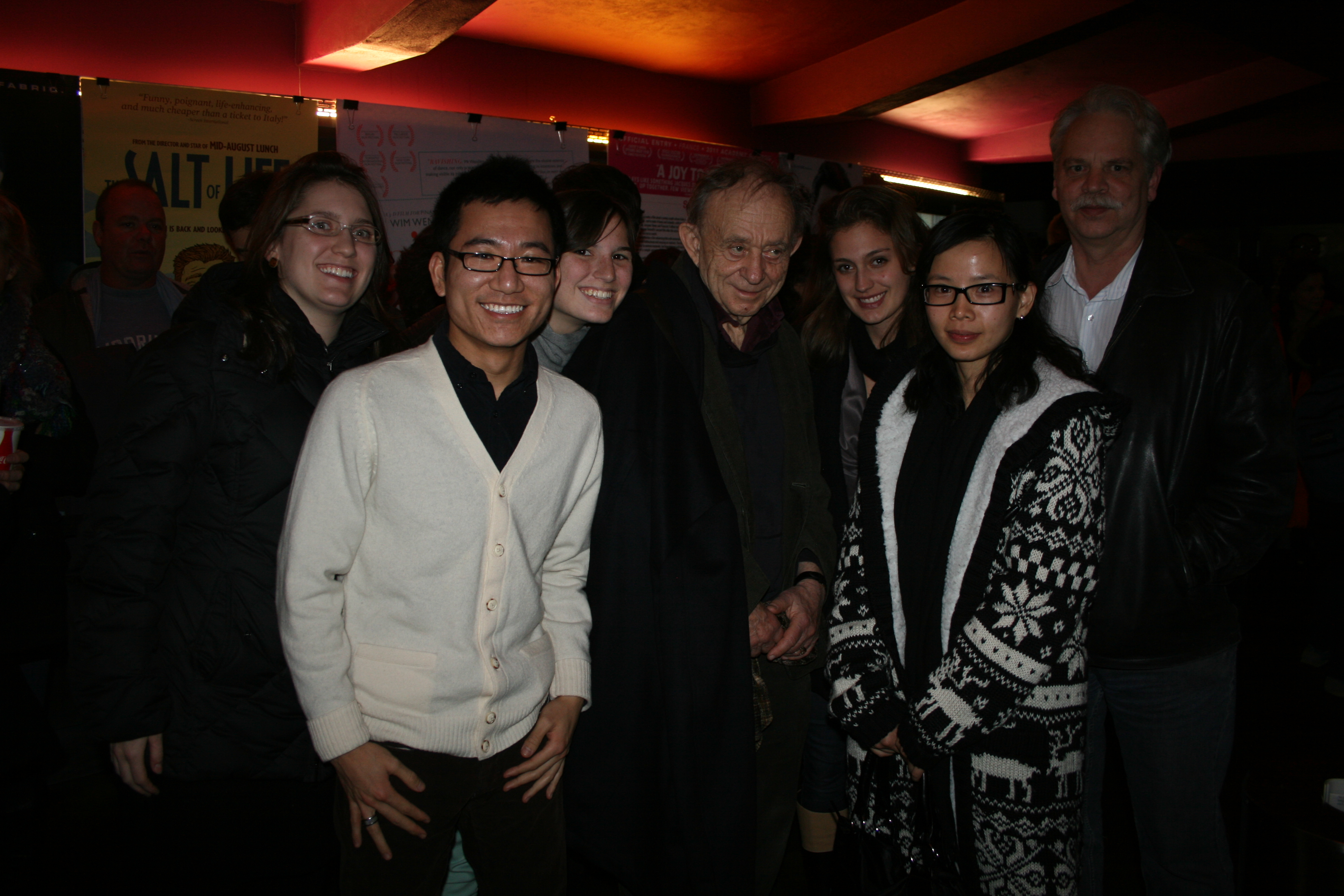
Frederick Wiseman & Titicut Follies at the IFC

Posted by chamus on January 18, 2012
Posted in: Uncategorized. Leave a Comment

We uncover gaps in our know- ledge -–and those of our students ––all the time.

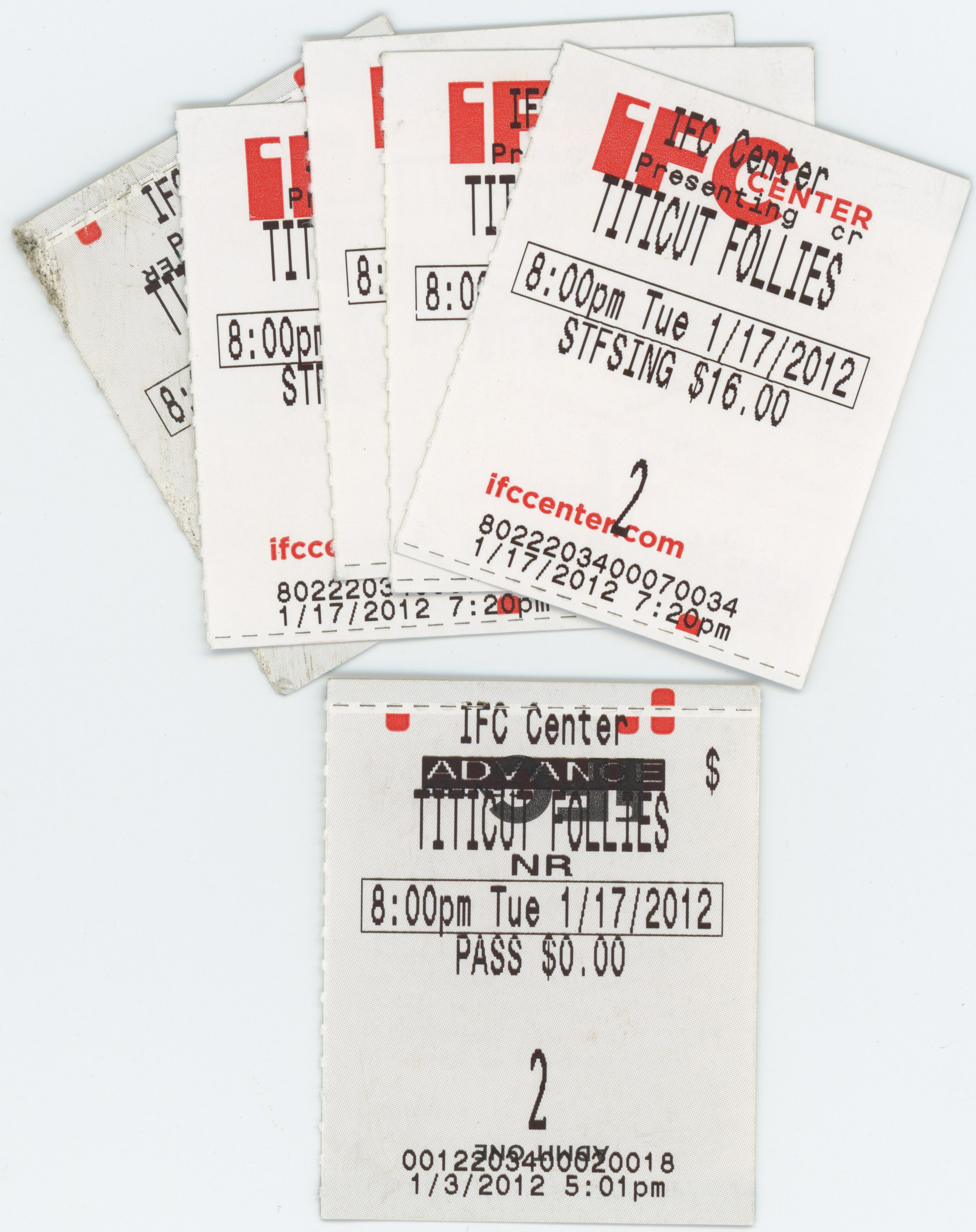
This past fall I mentioned the name and work of Frederick Wiseman to students in my Documentary Film Workshop course,  and they responded with an awkward silence.  Remedial viewing was obviously called for!  Then Wiseman was scheduled to show Titicut Follies (1967) at Stranger Than Fiction in NYC on Tuesday, January 17th.  So we went! 

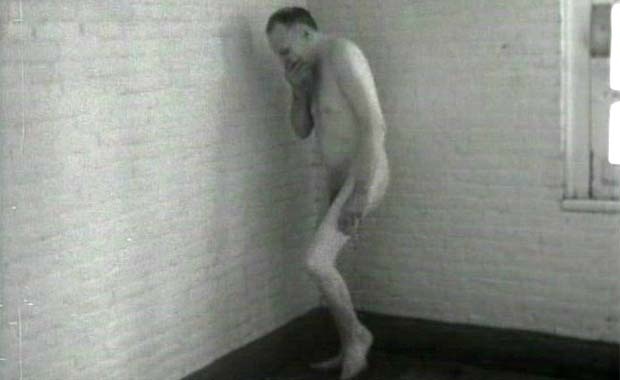
Titicut Follies (1967)

I’ve heard Wiseman speak quite a few times and seen Titicut Follies numerous times over the years.  In fact, Fred (the presumption on being on a first name basis does not feel entirely earned) received the Yale Film Studies Program Award in 2001–and has been to Yale on a number of different occasions. (He graduated from Yale Law School in 1954.)

Photo by Yelin Qiu

Besides the adventure of caravaning down to New York City with a group of students, there were a few things that made this experience a little different.

First. Because the film could only be shown under restricted circumstances for many years, I had always seen the film in a classroom or at least academic context ( like many other students in Film Studies).  This meant having a range of nontheatrical viewing experiences as a norm.  In contrast, the IFC showed a brand new print, and its projection was first rate.  In short, it was a theatrical experience–cinema and, of course, a cinefilic experience. So the narrative and performative aspects of the film, as well as the absurdist and surreal sensibility, came out quite strongly.  I suddenly felt that the early battle around censorship of Titicut Follies and the instrumental assumption that the film’s purpose was that of social reform have produced a particular set of somewhat limited analyses of the film.  Although Wiseman’s discussions of Titicut Follies generally reinforces this view, his picture has quite a bit in common with Shirley Clarke’s The Connection (1961).  And Wiseman had, of course, produced Clarke’s feature The Cool World (1964).  Some of his scenes shot in the prison yard reminded me of the opening scenes of The Cabinet of Dr. Caligari!

Second, my discussions with Errol Morris about Wiseman’s work have encouraged me to look at his films from a slightly different vantage point.  Errol’s favorite Wiseman film is Sinai Field Mission (1978), which came out the same year as his own Gates of Heaven.  He sees that little known Wiseman film as an absurdist comedy, which strikes me as an astute reading.  Perhaps some of Wiseman’s other films can and even should be seen from this perspective?  Despite its depiction of desperation, degradation and despair, an element of black comedy does run through Titicut Follies–as even the title suggests.

Normally I run into a number of documentary filmmakers at these STF events, but I suspect that many of them were waiting to go to the opening of Crazy Horse, which was opening at Film Forum the following evening.  The exception was Susan Meiselas, whom I got to know a little through Julia Preston and Richard Rogers.   By total chance I sat down right in front of her.  It turns out that, among other things, she was an assistant editor on Wiseman’s Basic Training.  When I was trying to get a group photo of my students with Wiseman and looking for someone to snap the picture–Susan was standing right there.

photo by Susan Meiselas

Li Jing, a post-doc from China who works at CCTV as a producer/director, videotaped the Wiseman Q & A   (led by former Yale Film Studies major Hugo Perez).  She used her cell phone and we are working on boosting the sound.  So here it is:

Being Elmo: A Puppeteer’s Journey

Posted by chamus on January 11, 2012
Posted in: Uncategorized. Leave a Comment


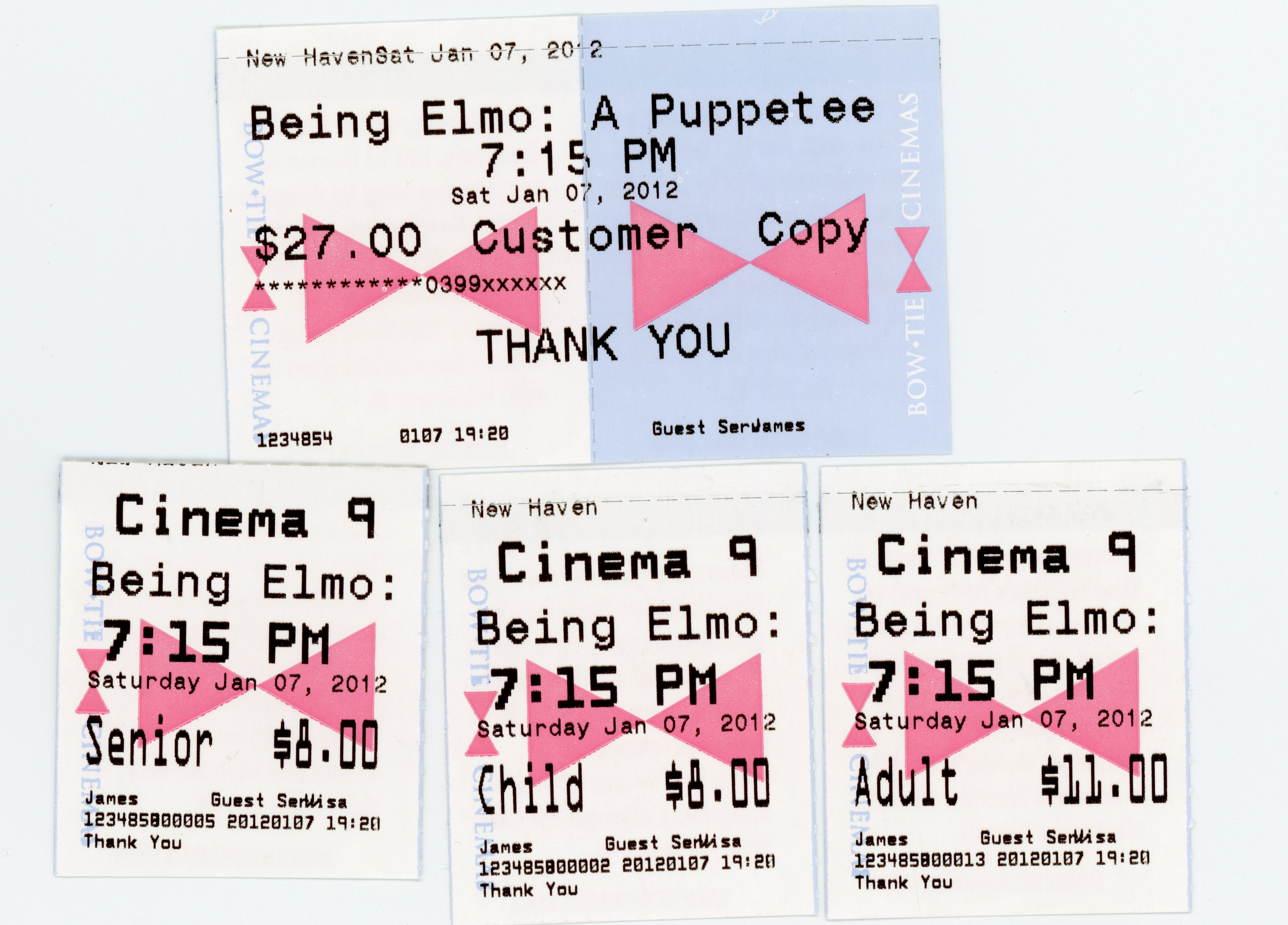
It wasn’t the first time this happened–only the second or third.  Take the family to a movie–Threese, John Carlos and myself–and we all get a different kind of ticket.  John Carlos (child) and I (senior) cost the same–a real discount.  Hmm.  I knew this was going to happened and joked about it.  Now it is real.

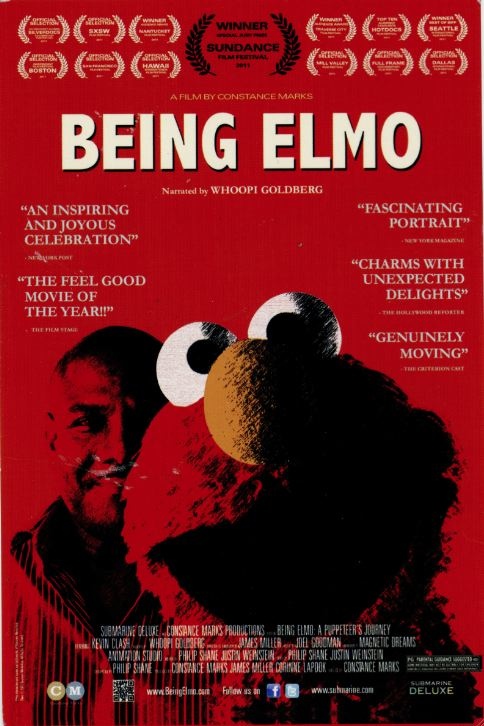
So Being Elmo was the only real option on that particular night–War Horse (even if Steven Spielberg) or The Girl with the Dragon Tattoo did not seem like the wise choice.  Besides here was a documentary–my thing these days–while JC had been a big fan of Elmo for quite some time, even if his current interest is Power Rangers (a step down to be sure).  So we went.  It was a sentimental choice since we all become very familiar with Elmo–“Elmo’s Song” was a particular favorite.  I liked Constance Marks’ documentary, in part, because it is a portrait of someone who could be overlooked as a side kick.  Shouldn’t one make a documentary about Jim Henson instead?  Of course, as it turns out, Kevin Clash was hardly an unknown, plucked from behind the scenes.  He had published an autobiography in 2006: My Life as a Furry Red Monster: What Being Elmo Has Taught Me About Life, Love and Laughing Out Loud. The result is a feel good movie–about someone with a passion that overflows his life.  I confess that it did strike me that puppeteering and the study of early cinema (even the study/making of documentaries) aren’t that different.  And I was hoping that was what Threese was thinking since puppeteer Kevin Clash certainly seems to be one of the nicer guys around.

So I’ll end with a digression or a comparison.  Being Elmo suddenly reminded me of a family version of the date movie.  I did not really fully understand the full meaning of a date movie until I took a date to see Amelie (2001).  The principle purpose of a date movie–at least that one–was to ensure that your date would come home with you at the end of the evening.  (I think that this is why that movie ran for months in New York City.  There must have been a lot of repeat business.)  Times change. The unintended but nonetheless real purpose of Being Elmo was for us all to head home together feeling a little closer. John Carlos was a little frustrated by the film–this was one of the first documentaries he had seen in a theater and he expected fiction (Hugo, etc.)  The film moves back and forth in its representational registers and he would have preferred Elmo straight up.  So for at least a few days, Sesame Street was playing on the home NFLX screen again.

Stranger Than Fiction: Wenders’ PINA in 3-D

Posted by chamus on December 21, 2011
Posted in: Uncategorized. Leave a Comment

I bought a winter pass for the ‘Stranger Than Fiction’ Winter Season at the IFC in NYC, which started off with Wim Wenders’ 3-D documentary Pina, on Pina Bausch.  I had just seen Werner Herzog’s Caves of Forgotten Dreams (2011)—on 3-D TV in Yale’s Film Study Center as the concluding film for the World Documentary course I was teaching with Raisa Sidenova––and was curious to see how these two veterans of the New German Cinema would deal with 3-D and Art.  Wenders was getting ready to make his documentary on Bausch when the dancer/choreographer died.  The film is really a portrait of dance troupe in mourning: they dance in her memory as individual dancers talk about their sense of loss.  If the essence of dance is bodies moving through space, 3-D would seem a natural vehicle for such a portrait.  Many of the scenes were wonderful in this respect but at other times bodies seemed to be flat cutouts arranged in space (something I found to be true for Scorsese’s Hugo as well).  Overall, it was a rewarding experience though my eyes ached by film’s end.  I wonder if this is what people felt when first seeing motion pictures in the 1890s?  Anyway, the documentary had loose ends—it was definitely not a biographical portrait which told the unfold story of Bausch’s life.  The four dances are never named nor the dates in which they are choreographed.  Indeed, to the uninitiated is not always clear that we are watching elements of fully developed dances as opposed to improvised movement.  Perhaps this sense of being at sea mirrors the disorientation that performers and filmmakers must have felt as they made the picture.  Or they knew their subject too well and lacked distance.  Anyway, I went to Wikipedia after the screening and I suspect that seeing the film after gaining a better overview of her career would yield a different, perhaps better effect.  (Nota bene:  the dangers of leaving too many loose ends for the viewer.  Perhaps I should add the years for Errol Morris’s documentaries in Lightning Sketch.)


The most interesting and innovative aspect of Pina was not the 3-D.  It was the interviews.  How did they come about?  Hard to know, but presumably Wenders interviewed members of the troupe and then had them perform his chosen excerpts of their interviews—silently, expressively. And on a couple of occasions, the dancers performed their silence.  A compelling, new approach to a too-familiar element of documentary, I think.  This alone made the film a memorable success in my book. The other element of this film I found compelling was its exploration of advancing age.  Age and dance are in brutal tension with each other.  Lifers are few, but Bausch was committed to allowing dancers to age.  One dance has three sets of actors –ages ca. 20 ca. 40-45 and ca. 60-70.  As we confront advancing age, works about growing old gracefully and vitally is something that catches our attention!


As for Cave of Forgotten Dreams.  Herzog finds an occasion to mobilize his theories of Ecstatic Truth by finding them realized in an earlier era.  Art as truth.  Art as an expression of the soul, such that without such as expression there is no soul.  So, Herzog suggests, this is the moment when the homo spiritualis was born.  The exploration of the cave through 3-D was lovely, emphasizing the contours of the space and underscoring these paintings were not done on flat surfaces.  And some of the cave paintings were stunning.  Particularly sobering were the drawings of rhinos, lions and some other animals long extinct in Europe.  These animals, which obviously flourished there (including cave bears), were relegated to Africa where they face an uncertain future.


With Cave of Forgotten Dreams, Pina and  Errol Morris’s Tabloid, 2011 was an interesting year for documentary.  Last night, I saw Buck, which is short-listed for the Oscars, at the STF/IFC.  The filmmaker was there as were quite a few dedicated horse people in the audience.  I didn’t have great expectations, but it was a lovely, complex biographical portrait of a cowboy-horse trainer, “Buck” Brannaman, who identifies with horses and shows how respectful, non-punitive treatment produces soulful results –for horse and rider. “Your horse is a mirror to your soul, and sometimes you may not like what you see,” he remarks. Herzog would embrace this topic as yet another instance of ecstatic truth.

Posts navigation

← Older Entries
Newer Entries →